

What Kind of Bed Does a Dachshund Need?
Your dachshund’s bed isn’t just a soft place to nap. It’s the one thing standing between a healthy spine and a painful injury. So what kind of bed does a dachshund need?
The direct answer is a low-entry bed with firm orthopedic support that lets your dog sleep flat and straight. Anything too soft, too high, or too small works against the breed’s vulnerable body.
The numbers back this up. As of 2026, the American Kennel Club lists the dachshund’s two size varieties as standard, roughly 16 to 32 pounds, and miniature, roughly 8 to 11 pounds. Both share the same long-backed frame and the same genetic risk for intervertebral disc disease.
That’s why bed choice matters more for this breed than almost any other.
A good dachshund bed keeps the spine supported in a neutral, straight line. It has a low profile so your dog can step in without jumping. It uses firm foam, not plush fiberfill, so the body doesn’t sink. And it should have a non-slip base and a washable cover. Those four features matter more than style or brand.

Why a Dachshund’s Body Changes the Bed Rules
A dachshund isn’t shaped like other small dogs. Its spine is long, its legs are short, and its proportions put the breed at high risk for intervertebral disc disease, often called IVDD. The condition happens when a disc bulges or ruptures into the spinal cord.
For dachshunds, it’s the most common serious spinal problem.
The bed you choose either helps or hurts that vulnerable spine. A bed that lets your dog’s back curve into a C-shape puts uneven pressure on those discs. A bed that keeps the back level and supported takes pressure off.
The dachshund breed profile from the American Kennel Club documents the breed’s spinal vulnerability, and it’s the reason support has to come first.
That’s also why the breed’s burrowing instinct needs a smart outlet. Dachshunds love to nest and dig at their bedding, a behavior worth understanding before you buy. But no amount of cozy design should ever trump basic back support.

What Matters Most: Support Over Softness
When most people shop for a dog bed, they squeeze the pillow and look for something plush. With a dachshund, that’s exactly backwards.
A bed that feels wonderfully soft to your hand will cave under a 20-pound dog’s body. The spine sinks, and the discs compress unevenly. That’s how a “comfortable” bed ends up contributing to back problems.
Firm orthopedic support is what dachshunds actually need. High-density memory foam, at least two to three inches thick, distributes weight evenly along the full length of the spine. Our memory foam breakdown explains why density matters more than brand name.
| Support Type | How It Feels | Effect on a Dachshund’s Spine |
|---|---|---|
| Polyester fiberfill | Plush and fluffy | Body sinks; spine curves |
| Egg-crate foam | Lightly cushioned | Moderate support; compresses quickly |
| High-density memory foam | Firm with slow give | Even weight distribution; neutral spine |
The Dachshund Club of America, the breed’s official parent club, echoes the same message. Back protection starts with the surface your dog sleeps on.
Key Bed Features for Dachshunds

A dachshund bed doesn’t need to be fancy. It needs to hit four specific marks.
Low Profile for Easy Entry
A dachshund should never have to jump to get into bed. Jumping off furniture is one of the main ways dachshunds injure their backs. The same logic applies to the bed on the floor.
Look for a sleeping surface that sits just two or three inches off the ground. If the bed has raised bolsters, make sure there’s a low step-in gap.
Firm Orthopedic Support
We covered this above, but it’s worth repeating: firm foam, not fiberfill. High-density memory foam, ideally two to four inches thick, supports the spine without letting the body sink. Press into the foam and you should feel slow resistance, not a deep, instant sink.
Non-Slip Base
This one is easy to overlook. When a dachshund stands up, it rounds its back and pushes upward. If the bed slides on a hardwood or tile floor, your dog’s feet can slip out from under it.
A rubberized or non-slip bottom anchors the bed in place.
Washable, Durable Materials
Dachshunds are diggers. They circle, scratch, and paw at their beds before settling in. That behavior is normal, but it shreds cheap fabric.
Look for a removable, machine-washable cover made from a durable weave. A waterproof liner under the cover makes cleanups far easier.
Comparing Common Dachshund Bed Styles
Now let’s lay out the main options. There are five bed styles dachshund owners commonly choose from.
| Bed Style | What It Looks Like | Best For | Watch Out For |
|---|---|---|---|
| Donut bed | Round with a continuous raised rim | Curling sleepers; security | Rim can sit too high |
| Bolster bed | Rectangular with raised edges | Dogs that like head support | Entry can be steep |
| Flat mattress bed | Open rectangle; low or no rim | Stretchers; senior dogs | Less sense of security |
| Cave or hooded bed | Enclosed den with a low opening | Burrowers | Can trap body heat |
| Orthopedic memory foam bed | Solid foam base, low profile | Back safety | Usually costs more |
The best style depends on how your dog sleeps. A dog that curls tightly feels secure in a donut or cave-style bed. A dog that stretches out needs a flat mattress or a low bolster bed.
In every case, the foam inside matters more than the shape outside.
How to Choose the Right Size Bed
Size is where most dachshund owners get it wrong. They buy based on the dog’s weight, not the dog’s actual length. And with a long-bodied breed, length is everything.
Here’s the process:
- Measure your dachshund from the tip of the nose to the base of the tail, with your dog standing straight.
- Add four to six inches for sprawl. That gives the minimum sleeping area that truly fits.
- Check the bed’s usable sleeping surface, not its total outer dimensions. Bolsters eat into the interior space.
- Match that number against the manufacturer’s listed dimensions.
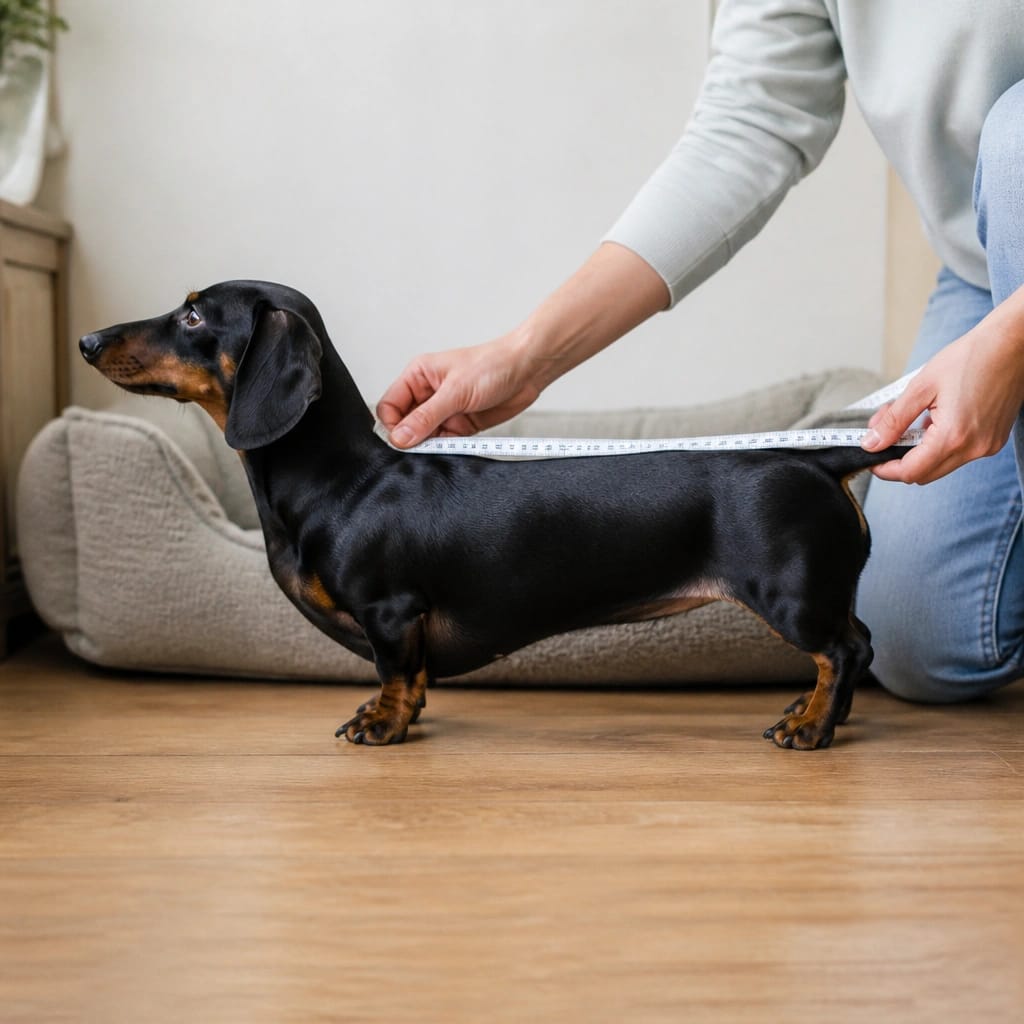
For a standard dachshund, nose-to-tail length typically falls between 20 and 26 inches. That means you want a usable sleeping area around 26 to 30 inches. For a miniature, the measurement drops to roughly 12 to 16 inches, so you’re looking at 16 to 22 inches of usable space.
In our research, we’ve noticed that many owners buy beds that are technically long enough but lose usable space to thick bolsters. Measure twice, and double-check the interior dimensions. Comparing your dachshund’s measurements against our size-by-weight chart can confirm whether you’re in the right range.


