

How Thick Should Dog Bed Foam Be?
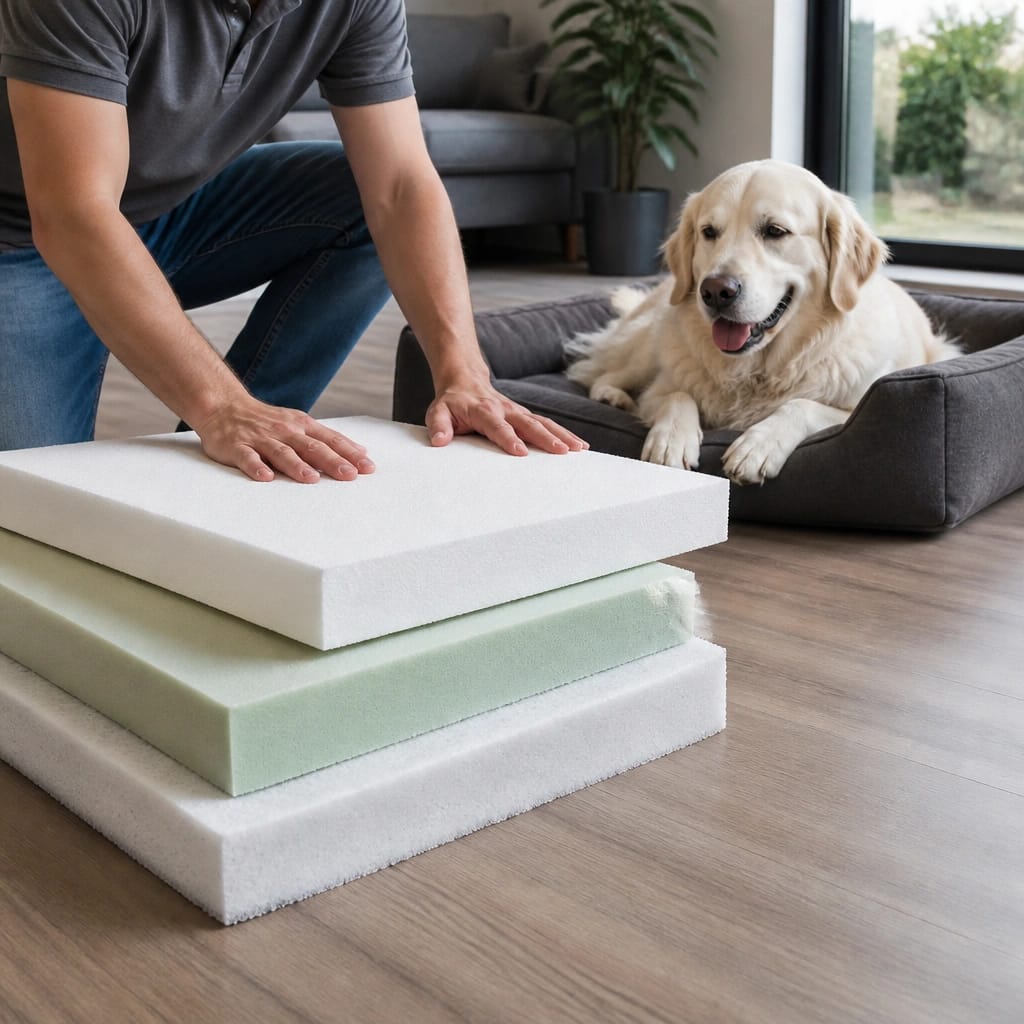
Foam thickness should match your dog’s weight. Dogs under 20 pounds need 2 to 3 inches. Dogs 20 to 50 pounds need 3 to 4 inches.
Dogs 50 to 80 pounds need 4 to 5 inches. Dogs over 80 pounds need at least 5 inches. Senior dogs and those with joint issues benefit from thicker, denser foam.
Always check the foam density too, high density prevents sagging.
Most dog owners don’t think twice about foam thickness until their dog starts sleeping on the floor instead of the bed. The truth is, the wrong thickness can make a bed useless no matter how much you paid for it. So how thick should dog bed foam be?
It depends on your dog’s weight, sleeping style, and health, but the short answer is: 2 to 5 inches, with heavier dogs needing the thicker end of that range.
A 2026 survey of orthopedic veterinary recommendations shows that the most common cause of dog bed rejection is inadequate support from foam that’s too thin or too soft. That’s why understanding thickness isn’t just about comfort, it’s about whether your dog will actually use the bed. Let’s break down exactly what to look for.
Why Foam Thickness Actually Matters for Your Dog
A dog bed isn’t just a soft place to lie down. It’s a support surface that distributes weight evenly and reduces pressure on joints. When the foam is too thin, your dog’s body bottoms out against the floor.
That creates painful pressure points, especially on elbows and hips.
Imagine sleeping on a mattress that’s only an inch thick. You’d wake up sore. Your dog feels the same way, but they can’t tell you.
They just stop using the bed, or they develop stiffness over time.
On the flip side, foam that’s too thick can be hard for small or elderly dogs to climb onto. That’s why there’s no single perfect number, the right thickness depends on the dog in front of you. Getting it right means better sleep, less joint pain, and a bed that actually gets used.
The Five Variables That Change the Answer
Thickness isn’t a one-size-fits-all number. You have to adjust it based on your dog’s specific situation. Here are the five factors that matter most.
Your Dog’s Weight
Weight is the biggest factor. A 10‑pound Chihuahua doesn’t need the same support as an 80‑pound Labrador. The heavier the dog, the more foam is needed to prevent them from sinking through to the floor.
As a general rule:
- Under 20 lbs → 2, 3 inches
- 20, 50 lbs → 3, 4 inches
- 50, 80 lbs → 4, 5 inches
- Over 80 lbs → 5+ inches
These are starting points. Adjust up if your dog is a senior or has arthritis, and adjust down if your dog sleeps in a crate with limited height.
Your Dog’s Age and Joint Health
Puppies have resilient joints and can handle thinner foam. Senior dogs, especially those with hip dysplasia or arthritis, need thicker, denser foam to cushion their joints during sleep. If your dog already shows signs of stiffness when getting up, err on the thicker side.
For older dogs, aim for at least 4 inches of high‑density memory foam. The extra depth helps distribute their weight and reduces the effort needed to stand back up. If your dog has mobility issues, consider a bed with a low profile, thick foam that’s too high off the ground can be just as problematic as thin foam that offers no support.
Sleeping Style: Curler, Stretcher, or Leaner
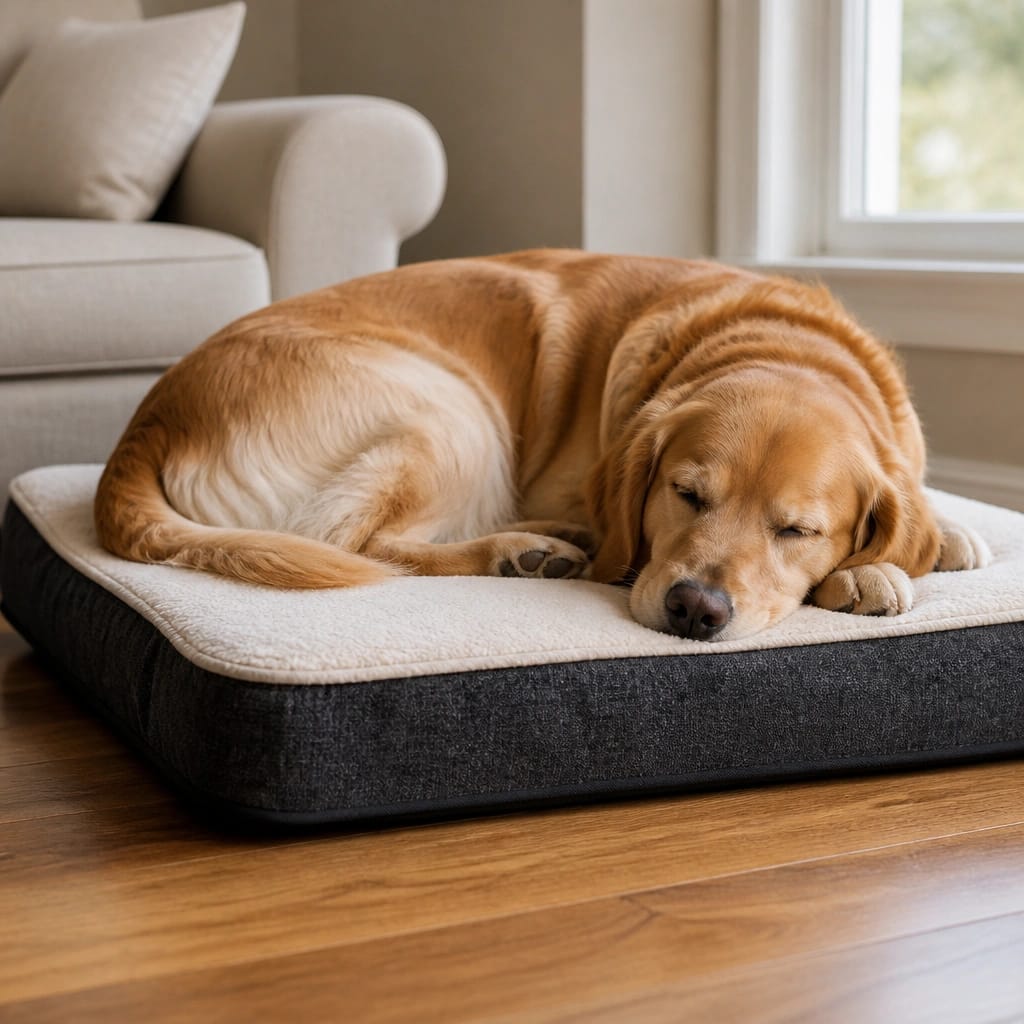
How your dog sleeps changes the way they interact with the bed. Curled‑up sleepers put most of their weight on a small area, so they need a thicker foam that won’t collapse under that concentrated pressure. Stretchers spread their weight over a larger surface, so a moderately thick foam often works fine.
Leaners, dogs who rest their head on a bolster or the side of the bed, need a thicker foam in the base to keep the bolster from sinking. If your dog likes to rest their chin on the edge, a thin base foam will let that bolster collapse, and your dog will end up with their head on the floor.
Crate vs Open Bed: Space Limits You Forgot
Crate beds are a different story. You have limited vertical space. Most crates have 4 to 6 inches of clearance above the floor when you factor in the crate tray.
If you put a 5‑inch thick foam pad in a crate with only 6 inches of height, your dog will be squished.
For crates, stick to 2 to 3 inches of foam. That’s usually enough for support without crowding your dog. If your dog is large and uses a crate, consider a crate‑specific bed or a pad with a thinner but denser foam core.
Open beds have no height limit, so go ahead and pick the thickness that matches your dog’s weight. Just remember that thicker foam means a heavier bed and a taller step‑up for your dog.
Foam Density and Firmness: The Hidden Metric
Thickness alone doesn’t tell the whole story. Two 4‑inch foam pads can feel completely different depending on their density and firmness. Density is measured in pounds per cubic foot, a 2‑lb density foam will compress much faster than a 4‑lb density foam.
For most dogs, you want a density of at least 2.5 lbs for polyurethane foam and at least 4 lbs for memory foam. Higher density means better support, longer life, and less sagging over time.
Firmness, or ILD (indentation load deflection), also matters. Soft foams (ILD 10, 20) are good for small dogs who like to nest. Medium foams (ILD 20, 35) work for most average dogs.
Firm foams (ILD 35, 50) are best for large, heavy dogs who need maximum support. A bed with a high‑density, medium‑firm foam is usually the safest bet across the board.
Decision Guide: Pick Your Foam Thickness by Weight
This simple table gives you a starting point based on your dog’s weight and the type of bed.
| Dog Weight | Recommended Thickness | Best Foam Type |
|---|---|---|
| Under 20 lbs | 2–3 inches | Medium density memory foam or polyurethane |
| 20–50 lbs | 3–4 inches | High density polyurethane or medium memory foam |
| 50–80 lbs | 4–5 inches | High density memory foam or firm polyurethane |
| Over 80 lbs | 5+ inches | Premium high density memory foam (4+ lb density) |
Keep in mind that these are minimums. If your budget allows, going one step thicker than the minimum gives you a safety margin. Also check the bed’s overall height, a 5‑inch foam core plus a 2‑inch bolster means your dog has to step up 7 inches.
For small or arthritic dogs, that might be too high.

Special Cases: Puppies, Seniors, and Heavy Chewers
Puppies are still growing, so you don’t need to invest in premium foam right away. A 2‑ to 3‑inch medium density foam is fine for a puppy. It’s also easier to replace when they outgrow it or if they have an accident.
Once your puppy reaches adult size, switch to a thickness that matches their full weight.
Seniors need extra care. As mentioned, 4 inches minimum is a good rule, but also look for foam with a CertiPUR‑US certification to ensure it’s free from harmful chemicals. Older dogs spend more time lying down, so the foam must hold up under constant pressure without sagging.
If your senior dog has trouble getting up, pair thick foam with a gentle slope or a low‑profile design.
Heavy chewers are a different challenge. They don’t care about foam thickness, they care about destroying the bed. If your dog chews, prioritize a chew‑proof cover over foam thickness.
You can learn more about safe materials in our guide on chew‑proof materials. For those dogs, a thinner foam pad inside a durable cover is better than a thick, expensive foam that gets shredded.
Three Common Mistakes That Ruin a Good Dog Bed
1. Going too thin for the dog’s weight. This is the most common mistake. A “one size fits all” bed from a big box store usually has 2 to 3 inches of foam.
That’s fine for a 30‑pound dog, but for a 70‑pound dog, it’s inadequate. The dog sinks through, develops pressure points, and stops using the bed.
2. Ignoring foam density. Thickness matters, but a 4‑inch foam with a density of 1.5 lbs will compress and sag within months. Always check the density spec before buying.
Higher density foam lasts longer and provides consistent support. If the product page doesn’t list density, that’s a red flag.
3. Forgetting about the bed’s overall height. A 5‑inch foam core plus a 3‑inch bolster equals an 8‑inch step. For a small dog or an older dog with arthritis, that step can be impossible.
Measure your dog’s leg length and make sure they can comfortably climb onto the bed. If not, look for a flatter design or a ramp.
Understanding your dog’s sleeping habits can also help you choose the right bed style. For instance, if your dog prefers to sleep on the edge of the bed, they may need a bed with a low profile and a supportive edge. And if you’re unsure about where to place the bed in your house, keep it away from drafts and high‑traffic areas to encourage use.
How to Tell if You’ve Chosen the Right Thickness
Your dog’s behavior tells you more than any spec sheet. If they snooze through the night without shifting positions, that’s a strong sign the foam is working. They should wake up without stiffness and choose their bed over the floor or your couch.
Try the hand test. Press your palm into the foam. If it sinks all the way to the floor, it’s too thin.
If your dog’s body leaves a deep crater, you need denser foam. A proper bed supports the surface while letting your dog settle in comfortably.
Also watch how they enter the bed. If they struggle to climb on, the bed is too high. If they circle and then flop down, that’s normal.
If they avoid the bed entirely, something about the foam or height is off. Our guide on measuring your dog for a bed can help you check the fit.
Frequently Asked Questions
Can I use thicker foam inside a crate?
Only if the crate has enough headroom. Measure from the crate tray to the top of the crate. Leave at least 2 inches of clearance above your dog’s head.
For most crates, 2 to 3 inches of foam is the practical limit.
Does thicker foam help with arthritis?
Yes, especially when paired with high density. A 4-inch or 5-inch memory foam core distributes weight more evenly and reduces pressure on painful joints. Senior dogs also benefit from a low-profile design that’s easy to step onto.
How long does dog bed foam last?
Standard polyurethane foam lasts about 1 to 2 years. High-density foam with a 4 lb rating can last 3 to 5 years. Watch for sagging, visible indentations, or your dog suddenly avoiding the bed.
That’s when to replace the insert.
Final Takeaway: Your Dog’s Support in One Number
Match the thickness to your dog’s weight, then check the foam density. Under 20 pounds needs 2 to 3 inches. Over 80 pounds needs at least 5 inches.
When in doubt, go slightly thicker and denser, but keep the bed’s height manageable.
Check your dog’s current bed. If it’s thin, sagging, or ignored, a new foam core might be all you need. If your dog also digs at their bed before lying down, pair the right thickness with a durable cover.
And if you ever deal with accidents, knowing how to clean foam properly will protect your investment.
Get the support right, and your dog will thank you with better sleep and healthier joints.


