

How to Size a Dog Bed for a Crate
Getting the right fit for a dog bed inside a crate isn’t just about comfort. It’s about safety, airflow, and whether your dog will actually sleep through the night. If you’re wondering how to size a dog bed for a crate, the short answer is: measure the crate floor, then measure your dog, then choose a bed that leaves a few inches of breathing room on every side.
A bed that’s too small leaves your dog on hard plastic, while a bed that’s too large bunches against the crate walls and can block the door or trap heat.
Manufacturer specifications for crates typically list interior dimensions in inches, but those numbers don’t always match real-world measurements. As of 2026, most standard wire crates still follow the familiar 24, 30, 36, and 42-inch size labels, though actual floor space varies by brand. That’s why the bed size chart on a package means less than your own tape measure.
Measure your dog from nose to the base of the tail. Measure the crate floor from front to back and side to side. The bed should be slightly smaller than the crate floor. Leave 2 to 4 inches of clear space around all sides. That prevents bunching, keeps airflow open, and lets the crate door close safely.

Why Crate Bed Size Actually Matters
Too big is just as bad as too small. A bed that crowds the crate walls folds and bunches. That creates lumps your dog has to sleep on.
It can also block airflow, especially in wire crates, and cause the door to rub or jam.
A properly fitted bed sits flat and stable. That stability is what tells your dog this is a safe place to settle. When a bed keeps sliding around, some dogs give up and lie on the crate floor instead.
That’s a missed opportunity for comfort.
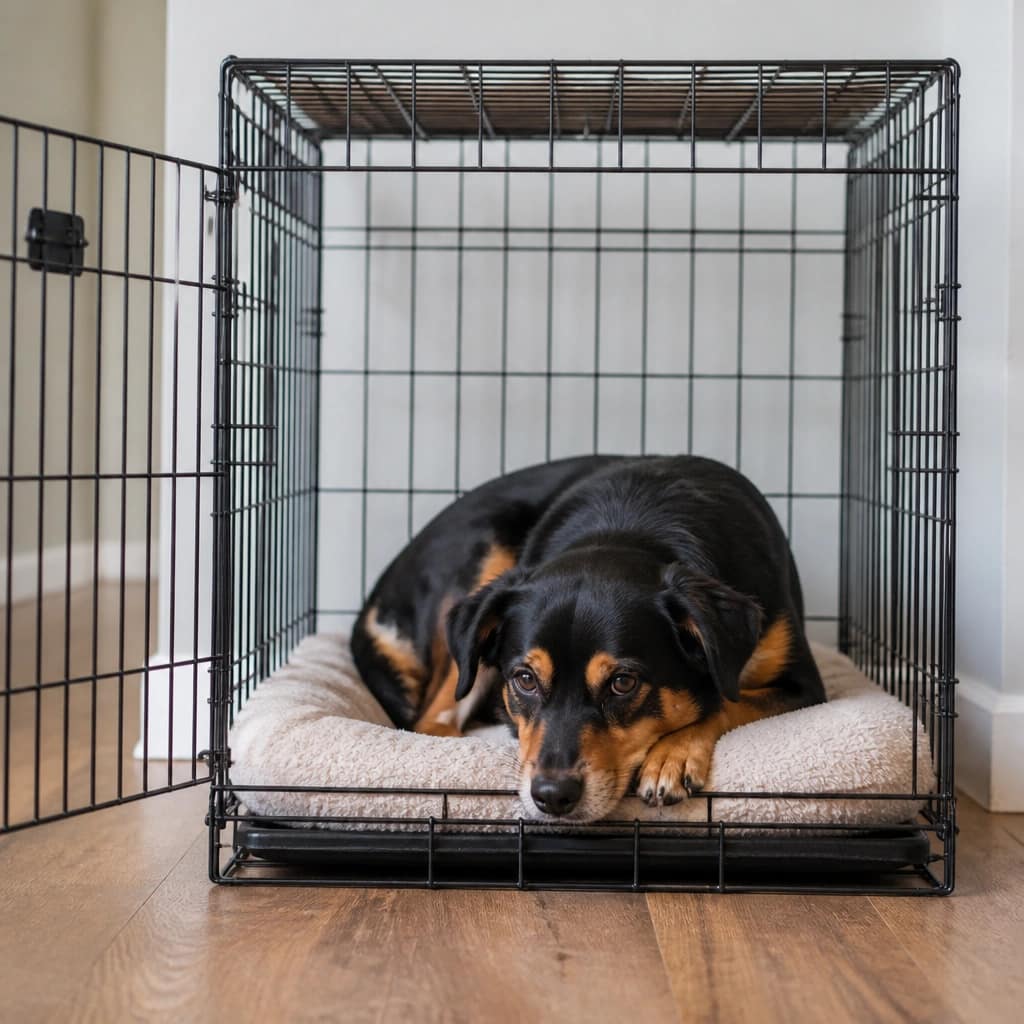
Veterinarians and organizations like the American Kennel Club all stress the same rule: your dog needs room to stand, turn around, and lie down comfortably. If you’re still deciding whether your dog needs a bed at all, our complete guide to dog beds walks through the options by sleeping style and living situation.
The Two Measurements That Decide Everything
Before you shop, grab a soft measuring tape. You’re going to take two numbers: your dog’s body length and the crate’s usable floor space.
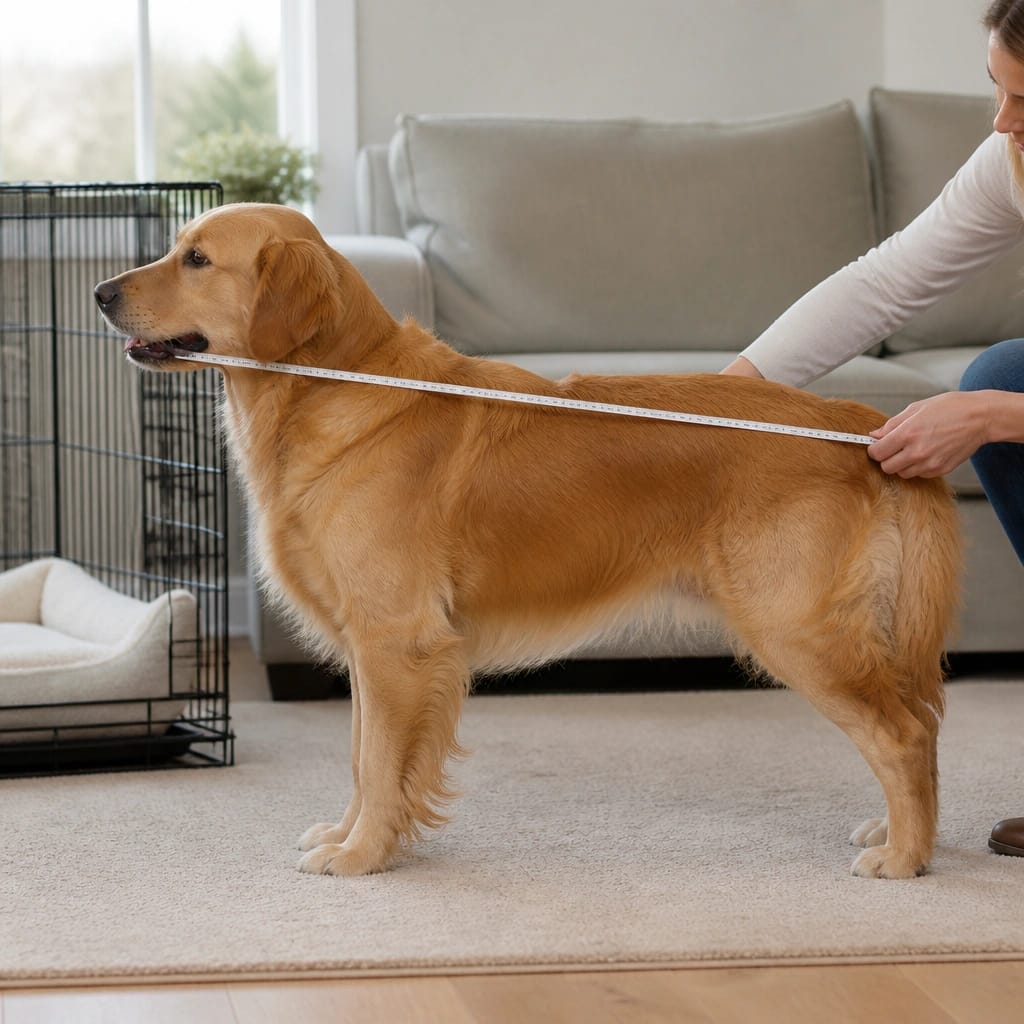
- Measure your dog from the tip of the nose to the base of the tail. Not the tip of the tail. The base. That number is your minimum bed length.
- Measure the crate floor from the back wall to the inside edge of the door. Then measure side to side. Write both numbers down.
Your bed must fit inside the crate floor, not match it exactly. Leave 2 to 4 inches of clearance on every side. That gap prevents the bed from catching the door and lets air move freely around your dog.
If your dog regularly chooses the bare floor over the bed, the dimensions might be off. A bed that’s too big is just as annoying to lie on as one that’s too small.
How Your Dog Sleeps: Curled Up, Stretched Out, or In Between?
Now measure based on their favorite sleeping pose. Dogs fall into three camps.
- Curled up in a ball: their sleeping length is shorter than their full body length. You can size down by 2 to 4 inches.
- Stretched out on their side: use their full body length, plus an inch or two of slack.
- In-between, with legs tucked and head up: aim for the full body length, but allow a bit more width.
If your dog has a strong burrowing instinct, a snugger fit can feel more secure. It gives them something to push against while they nest.
Matching Crate Size to Bed Size Without the Guesswork
Use these as starting points, then adjust for your own crate and dog. These are approximations based on common crate models.
| Crate Size | Interior Dimensions (approx) | Suggested Bed Size |
|---|---|---|
| 24-inch | 24 x 18 inches | Crate mat around 22 x 16 inches |
| 30-inch | 30 x 19 inches | Bed around 27 x 18 inches |
| 36-inch | 36 x 23 inches | Bed around 33 x 22 inches |
| 42-inch | 42 x 28 inches | Bed around 38 x 26 inches |

Remember, a bolt that says “large” on the label might not match your crate. Always compare the bed’s listed dimensions to your own measurements.
If you prefer a bed with raised edges, check a bolster bed’s full dimensions before buying. The raised rim takes up floor space that your dog can’t sleep on.
Does Bed Type Change the Fit? Bolster, Flat, and Orthopedic
Yes. The bed type changes the usable fit even when the length and width are right.
- Flat mats and crate mats are the easiest. Low profile, no top edge to catch, and they work well in travel crates with limited headroom.
- Bolster beds look cozy but take up 2 to 4 inches on each side. That leaves less room for your dog to stretch.
- Orthopedic foam beds are thicker, which matters if your crate’s height is short. Measure from the crate floor to the crate top, then subtract the bed height.
Your dog still needs to stand up, turn around, and lie down comfortably. That’s not just comfort, that’s safety.
If you’re looking at thicker options for joint support, our memory foam dog bed breakdown covers what to watch for in the height department.
Bed Thickness and Headroom: The Overlooked Dimension
Length and width aren’t the full story. You also need to check the bed’s thickness against your crate’s height.
Measure from the crate floor to the top of the crate. Then subtract the bed’s height. Your dog needs enough clearance to stand, turn around, and change positions without squishing against the top.
In wire crates, a thick bed can also block airflow near the floor. That traps heat in summer and can make a senior dog uncomfortable. If headroom is tight, a low-profile mat is usually the safest call.
Orthopedic options come in different heights. If you want the joint support of a thicker pad, our memory foam guide has useful details on balancing height with fit.
Sizing for Puppies: Plan for Growth, Not Just Today
Puppies grow fast. A bed that fits this week won’t fit in two months.
If you’re using a crate divider, measure only the section your puppy currently has access to. That’s the exact floor space the bed must fit. Don’t size the bed to the whole crate unless you remove the divider.
Plan for an upgrade. For growing pups, a thinner, washable mat is more practical than a pricey orthopedic bed. You’ll replace it anyway.
If you’d rather buy once, skip the puppy phase with a cheap interim mat and buy the adult-size bed when they finish growing.
Chewers, Diggers, and Nesting Dogs: When Behavior Changes the Sizing Rules

Behavior changes what counts as a proper fit.
For chewers, a bolster bed is risky. Foam and fiberfill can be shredded and swallowed. A flat mat that lies flush with the crate walls has fewer edges to grab.
It won’t bunch, either.
For diggers, the same logic applies. A bed that slides and folds gives them something to tear into. A snug, flat fit removes that temptation.
Nesting dogs are different. They like something to push against while settling. A slightly snugger bed can feel more den-like for them.
Just watch that the bed doesn’t catch under the crate door. If your dog loves to burrow, our calming donut bed explains how rounded shapes support that instinct.
Common Crate Bed Sizing Mistakes (and How to Avoid Them)
These are the mistakes we see most often in research and buyer feedback.
- Trusting the S, M, L label. Those labels vary wildly between brands. Always compare listed dimensions to your own crate.
- Measuring your dog’s full height instead of sleeping length. Sleeping length is the number that matters.
- Forgetting door clearance. A bed that fits the floor can still catch the sliding door if it’s too thick.
- Sizing up for comfort. Bigger is not better inside a crate. Extra space shifts and folds.
- Ignoring the height factor. A perfect floor fit means nothing if your dog’s head hits the top.
A Simple 4-Step Decision Guide for Any Crate
Run through these four checks before you buy.
- Measure the crate floor. Length and width, in inches.
- Measure your dog from nose to tail base. Add 2 to 4 inches for clearance.
- Measure the crate height. Subtract the bed’s thickness. Your dog needs room to stand comfortably.
- Match the shape to the sleeping style. Curled sleepers can size down slightly. Stretched sleepers need the full length.
If the bed passes all four checks, it fits. If it fails any one, keep looking. You’ll know within a minute whether a bed belongs in your crate.
Quick FAQ: Crate Bed Sizing
How Big Should a Crate Bed Be?
Add 2 to 4 inches to your dog’s nose-to-tail length. The bed must sit flat inside the crate with a small gap on all sides.
Should I Buy a Bed That Fills the Crate?
No. Leave a little space around the bed. That prevents bunching, keeps airflow open, and helps the crate door close safely.
What’s the Best Bed for a Chewer?
A flat, chew-resistant mat. No bolsters, no thick foam edges. A snug fit matters because loose fabric invites digging.
The Bottom Line: What to Do Before You Click Buy
Pull out your tape measure. Check the crate floor and your dog’s sleeping length. Compare both against the bed’s listed dimensions.
Account for height too.
If it passes all four checks, it’s worth buying. If not, keep looking. The right fit is flat, snug, and safe.


