

How to Choose a Temporary Bed for a Growing Puppy?
You need a temporary bed for your puppy because they will outgrow a permanent one in weeks. The best choice depends on your puppy’s age, chewing habits, and crate size. A cheap, washable option saves you money and frustration. Focus on durability, easy cleaning, and the right fit for now.
Puppies grow fast. A large breed pup can gain 2 to 5 pounds per week, which means a bed that fits today might be cramped in a month. Spending a lot on a permanent bed before you know your dog’s adult size is a gamble you do not need to take.
A temporary bed bridges that gap without breaking the bank. As of 2026, the average cost of a decent temporary puppy bed runs between $8 and $30, far less than the $50 to $120 you would spend on a quality adult bed that might end up too small.

Why a Temporary Bed Makes Sense for a Growing Puppy
A temporary bed is not a compromise. It is a smart strategy. Think of it as a placeholder until your puppy reaches their full size, which can take anywhere from 6 months for small breeds to 18 months for large ones.
Here is what a temporary bed does for you:
- Saves money. You avoid buying a $100 bed that your puppy outgrows in two months.
- Reduces waste. Puppies chew, dig, and sometimes have accidents. An expensive bed ruined by a teething pup is a hard loss.
- Makes crate training easier. A bed that fits the crate perfectly helps your puppy feel secure.
- Gives you time. You can wait until your dog is fully grown before investing in a permanent bed that matches their size and sleeping style.
If you have ever watched a puppy shred a brand new bed in under an hour, you already know why a temporary option is the smarter play. Your puppy’s sleeping habits will change as they grow, and a temporary bed lets you adjust without regret.

The Temporary Bed Options You Actually Have
You have four main choices. Each one works for a different situation. Knowing which one fits your puppy’s current stage is the key.
| Option | Best For | Typical Cost | Washable? |
|---|---|---|---|
| Old towels or blankets | Newborn to 8 weeks, budget-first owners | Free to $5 | Yes |
| Crate mat or flat pad | 8 weeks to 6 months, crate training | $10 to $25 | Yes |
| Elevated cot bed | Teething phase, warm climates, heavy chewers | $15 to $30 | Usually |
| Cheap disposable dog bed | Travel, foster homes, short-term use | $8 to $15 | Varies |
Each option has trade-offs. The right one depends on your puppy’s age, size, and behavior right now. Let us break them down.
Old Towels and Blankets: The Budget-Friendly Starter
Old towels and blankets are the most affordable temporary bed you can use. They are also the easiest to replace when your puppy has an accident or chews a hole in one.
Pros:
- They cost nothing if you already have them.
- You can wash them in hot water with bleach if needed.
- You can layer them for warmth or remove layers for cooling.
- They are safe for very young puppies who cannot climb over a raised edge.
Cons:
- They do not provide much padding or support.
- Puppies can bunch them up and sleep on the bare crate floor.
- Frayed edges can become chewing targets.
- They slide around on smooth crate trays.
Our research shows that many owners start with towels for the first few weeks and then switch to a crate mat once the puppy is housebroken. If you use towels, tuck the edges underneath or tape them to the crate tray so your puppy cannot pull them into a pile.
For a newborn puppy still with their litter, towels are ideal. Once your puppy starts chewing and exploring, you will want something more durable.
Crate Mats and Flat Pads: The Practical Middle Ground
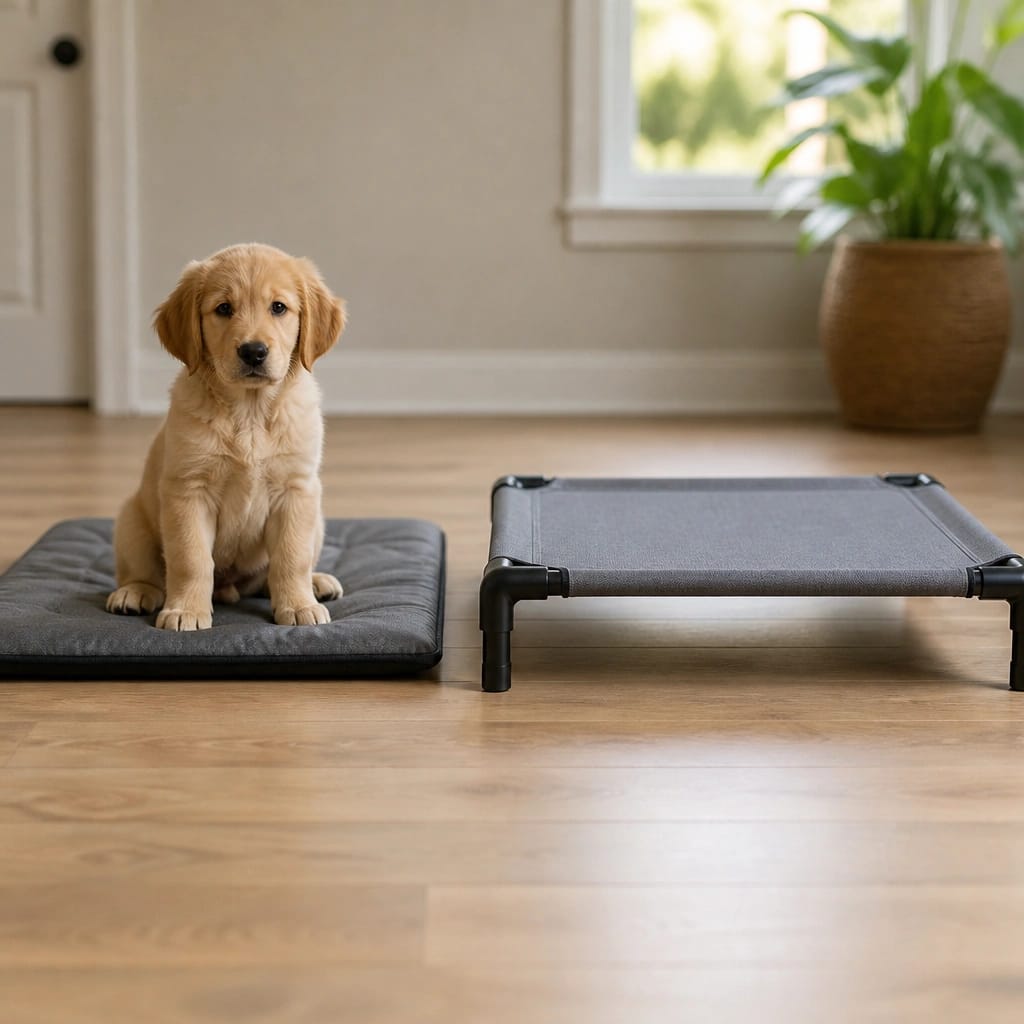
A crate mat or flat pad is the most common temporary bed for puppies. It is thin enough to fit inside a crate, washable, and more durable than a towel.
What to look for:
- Waterproof backing. This protects the crate tray from accidents. A mat without a waterproof layer will soak through and smell.
- Machine washable. You will be washing it every few days. Look for a mat that can go in the washing machine without falling apart.
- Non-slip bottom. A mat that slides around drives puppies crazy and can make them reluctant to settle.
- Chew-resistant fabric. Cordura nylon or heavy canvas holds up better than cheap polyester.
A good crate mat costs between $10 and $25. That is a fair price for something that will last 3 to 6 months. If your puppy is a heavy chewer, you might go through two or three mats in that time.
Manufacturer specifications indicate that most crate mats are designed for dogs up to 30 pounds. If your puppy is a large breed, measure the crate interior and look for mats that match the dimensions. A mat that is too big will fold up and create an uneven surface.
Elevated Cot Beds: Worth It During Teething Season?
An elevated cot bed lifts your puppy off the floor. Air circulates underneath, which keeps them cool during teething when their body temperature runs higher. It also removes the temptation to chew on the edges of a soft bed.
When an elevated cot makes sense:
- Your puppy is teething (3 to 6 months old) and chewing everything.
- You live in a warm climate and your puppy tends to overheat.
- Your puppy has already destroyed one soft bed.
- You need a bed that is easy to hose off and dry.
When to skip it:
- Your puppy is still very small and might slip through the slats.
- Your puppy is nervous and needs a soft, enclosed space to feel safe.
- The cot does not fit your crate (most cots are designed for wire crates).
Elevated cots range from $15 to $30. They are more durable than crate mats but less comfortable for puppies who like to burrow or nest. If your puppy likes to dig before lying down, a cot handles that behavior better than a mat.
Our research shows that elevated cots work best as a second bed for daytime use. Keep a soft mat in the crate for overnight and use the cot for supervised naps in the living room. That way your puppy gets the best of both worlds.
Cheap Disposable Beds: When to Buy and When to Skip

A cheap disposable bed is a thin, low-cost pad from a discount store. It costs $8 to $15 and is not built to last. Use it for travel, short-term fostering, or as a backup when the main bed is in the wash.
Skip it if: your puppy is a heavy chewer, still having accidents, or needs joint support. These beds usually lack waterproof backing and chew-resistant fabric. One accident and the foam core is ruined.
Aggregate buyer feedback shows these beds last about 4 to 6 weeks with a calm puppy. For a teething Lab mix, expect maybe two weeks. They serve a purpose but are not a primary solution.
Side-by-Side Comparison: Cost, Durability, and Washability
| Option | Cost | Lifespan | Washable | Best For |
|---|---|---|---|---|
| Towels / blankets | Free – $5 | 2–4 weeks | Yes, hot water | Newborn to 8 weeks |
| Crate mat / flat pad | $10 – $25 | 3–6 months | Yes, machine wash | Crate training, general use |
| Elevated cot | $15 – $30 | 6–12 months | Hose off | Teething, warm climates |
| Disposable pad | $8 – $15 | 2–6 weeks | Sometimes | Travel, backup use |
A crate mat offers the best balance of cost and durability for most puppies. If you want something that survives the full teething phase, consider a waterproof option designed for easy cleanup.
Choosing Based on Your Puppy’s Age and Size

Your puppy’s age determines what they need. Use the AKC breed-specific growth charts to estimate adult size and plan your temporary bed accordingly.
8 weeks to 4 months: Use a crate mat or towels. Your puppy is still small and may have accidents. A waterproof mat protects the crate.
4 months to 6 months: Teething starts. An elevated cot or a chew-resistant crate mat works best. Save the expensive bed for later.
6 months and older: Your puppy is closer to adult size. You can start looking at a permanent bed. Check our size guide to compare puppy versus adult dimensions.
Choosing Based on Crate Size and Setup
Your crate size dictates bed dimensions. A bed that is too big folds up and creates an uneven surface. A bed that is too small leaves hard plastic exposed.
Measure the crate interior length and width. The bed should be 2 to 3 inches shorter on each side. This prevents bunching and gives your puppy room to stretch.
For wire crates with a divider panel, measure the actual space your puppy occupies. As you move the divider back, you can size up the bed. Many owners use a crate mat that fits the current section and then buy a larger one later.
Common Mistakes That Cost You Money and Time
Buying an expensive bed too early. A $100 bed for an 8-week-old puppy is a waste. Chances are high it gets chewed or outgrown.
Ignoring washability. If a bed cannot go in the washing machine, do not buy it. Puppies have accidents, drool, and track in mud.
Skipping waterproof backing. Urine soaks through fabric and into the foam. The smell is nearly impossible to remove. A waterproof layer prevents this.
Getting the wrong size. A bed that is too big for the crate encourages your puppy to eliminate on one end and sleep on the other. This undermines house training.
When to Transition to a Permanent Adult Bed
Switch to a permanent bed when your puppy reaches about 80 percent of their expected adult size. For small breeds, that is around 6 months. For large breeds, it is closer to 12 months.
You want a bed that fits their adult sleeping position. Some dogs stretch out. Others curl up.
A donut or bolster bed works well for cuddlers. A flat, supportive foam bed suits sprawlers. Once your puppy stops chewing everything, you can invest in a quality bed that lasts years.
Frequently Asked Questions
How long does a temporary puppy bed need to last?
Most puppies need a temporary bed for 3 to 6 months. Small breeds reach adult size faster. Large breeds may need a temporary bed for up to 12 months.
Can I use a human pillow or cushion for my puppy?
Not safely. Human pillows have soft fillings that can become a choking hazard. They also lack waterproof backing and are hard to clean properly.
What if my puppy chews through every bed I try?
Switch to an elevated cot bed. Puppies cannot grip the edges to chew them. You can also use a heavy-duty chew-proof crate mat made from ballistic nylon.
Should I buy a bed that my puppy can grow into?
No. A bed that is too big for the crate encourages your puppy to eliminate on one end. Buy a temporary bed that fits the current crate size.
How often should I wash the temporary bed?
Wash it every 3 to 5 days during the housebreaking phase. Once your puppy is reliably clean, every 1 to 2 weeks is enough. Use hot water and a pet-safe detergent.


