

How to Choose a Dog Bed for RV Travel
How to Choose a Dog Bed for RV Travel
Picking the right bed for your dog might seem simple at home, but it gets a lot trickier when you’re living in a moving vehicle. How to Choose a Dog Bed for RV Travel is about finding something that stays put, fits your limited floor space, and handles the constant temperature swings you’ll hit on the road.
Most RV owners underestimate how much a bed will slide around during a turn or how quickly foam can degrade in a hot camper. As of 2026, manufacturer specifications for portable pet beds show a clear split between indoor-only designs and travel-grade construction. The wrong choice means your dog sleeps on a slippery, lumpy mess.
The right one means they settle down fast, even in a new campground every night.
Pick a dog bed that won’t slide on your RV floor. Measure your available space before you buy. Match the bed type to how your dog travels.
Choose materials that handle heat, cold, and moisture. Avoid beds that are too bulky to store.
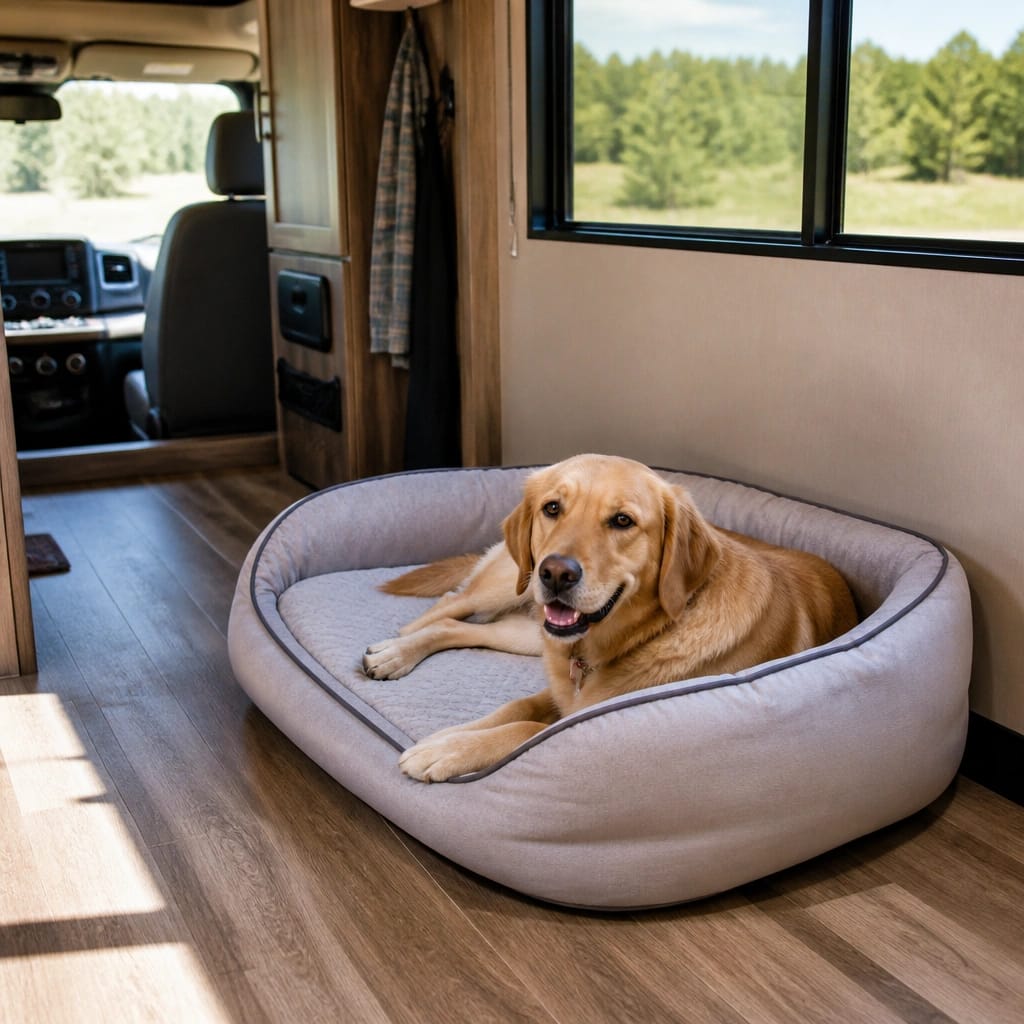
Why Your RV Needs a Different Kind of Dog Bed
A standard dog bed works great in a living room. It’s a disaster in an RV. You’re dealing with constant motion, sharp turns, and sudden stops.
A bed that stays put on carpet will slide across vinyl or linoleum like a hockey puck.
Then there’s the space problem. Most RVs don’t have a dedicated spot for a dog bed. You’re squeezing it between the dinette and the slide-out, or wedging it into a bunk that’s 30 inches wide.
A bed that’s too big eats up all your floor space. One that’s too small leaves your dog uncomfortable.
Temperature is another factor. RVs get hot in summer and cold in winter, especially when you’re parked without hookups. A thick memory foam bed that feels great in a climate-controlled house can turn into a heat trap or freeze solid depending on the season.
The bottom line is this: your dog needs a bed that’s designed for movement, confined spaces, and changing conditions. The same logic applies to where you put it at home, but the stakes are higher when you’re living on the road.
What Makes a Dog Bed Work for RV Travel — The 5 Key Features

Not every travel bed is created equal. Our research into aggregate reviews and manufacturer specs points to five features that separate a good RV bed from a wasted purchase.
| Feature | Why It Matters | What to Look For |
|---|---|---|
| Non-slip bottom | Prevents sliding during turns and stops | Rubberized or silicone grip dots, not just a fabric backing |
| Right size and shape | Fits your specific floor space or crate | Measure width and length of the area, not the bed’s listed size |
| Easy to clean | Accidents, mud, and spills happen on the road | Removable, machine-washable cover with a waterproof liner underneath |
| Temperature-appropriate materials | Keeps your dog comfortable in heat or cold | Cooling fabric for summer, insulated base for winter, or a raised cot for airflow |
| Durability for constant movement | Withstands packing, unpacking, and shifting | Reinforced seams, heavy-duty zippers, and chew-resistant corners |
If your dog travels in a crate, the bed needs to fit the crate interior exactly. If they free-roam, you need a non-slip base and a size that leaves room for you to walk past. If you’re in a van or small camper, a foldable or rollable bed is easier to store during the day.
Step 1: Measure Your Space Before You Shop

This is the step most people skip, and it’s the one that causes the most frustration. You can’t guess the right size. You need to measure the actual space where the bed will live while you’re parked and while you’re driving.
Start with the floor area. If your dog sleeps in a specific spot, measure the width and length of that space. Include any obstacles like slide-out rails, cabinets, or the dinette legs.
Write those numbers down.
Next, measure your crate if you use one. Crate dimensions are usually listed as interior length and width. You want a bed that fits flush against the walls, not one that curls up at the edges.
A bed that’s too big can create a tripping hazard or block airflow.
Finally, think about storage. When you’re not using the bed, where does it go? If you need to stow it in a cabinet or under a seat, measure that opening too.
A bed that’s too large to store will end up piled on the couch, which defeats the purpose.
For a more complete guide on figuring out the right dimensions, check our dog bed size chart by weight. It gives you a starting point, but RV spaces are unique, so trust your tape measure first.
Step 2: Match the Bed Type to How You Travel

Your travel style determines the best bed type. There’s no universal winner. Here’s how the options break down.
If you use a crate, A crate pad is your best bet. It’s thin, firm, and fits snugly inside the crate. Your dog can’t push it around or chew the edges.
The main trade-off is less cushioning, so a foam insert with a waterproof cover is ideal. We have a detailed comparison on choosing between crate pads and crate mats that explains the differences.
If your dog free-roams, You need a non-slip floor bed with a rubberized bottom. A flat mat or a low-profile bolster bed works well. Avoid anything with a loose cover that can bunch up.
Bolster beds are popular for dogs that like to rest their head, but they take up more space.
If you drive long hours, A car seat cover or a dog hammock for the back seat is the safest option. It keeps your dog secure and protects your upholstery. When you stop, you can transfer them to a separate bed for the campsite.
If you’re short on floor space, A raised cot bed is a smart choice. It lifts your dog off the cold floor and provides airflow underneath. It’s also easy to fold and store.
The downside is less padding, so it’s not ideal for senior dogs with joint issues.
If your dog is anxious or nervous on the road, A cave-style or hooded bed can help them feel secure. The enclosed design muffles noise and blocks visual distractions. Find more on that in our guide to bedding for nervous travelers.
Step 3: Consider Your Dog’s Specific Needs
Your dog’s age, size, health, and behavior all play a role in the decision. A bed that works for a young Labrador won’t work for a senior Chihuahua with arthritis.
Senior dogs and dogs with joint problems need orthopedic foam. Look for at least 3 inches of high-density memory foam or a similar supportive material. A bed that’s too thin won’t provide enough cushioning on hard RV floors.
If your dog has hip dysplasia or arthritis, prioritize support over portability.
Puppies and young dogs are harder on beds. They chew, dig, and scratch. You need a cover made from tough, chew-resistant fabric.
Skip anything with loose fill or exposed zippers. A crate pad is often the safest choice until they outgrow the destructive phase.
Dogs that dig or scratch at their bed before lying down need a surface that can take abuse. Look for reinforced seams and a heavy-duty bottom panel. Some dogs scratch because they’re trying to get comfortable.
Others do it out of habit. Our article on why dogs dig at their bed explains the behavior.
Dogs that overheat need a cooling bed or a raised cot. Memory foam retains heat, so avoid thick foam in hot climates. A cot with a mesh surface allows air to circulate underneath.
If you’re traveling in summer, this is a non-negotiable feature.
Dogs that get cold need insulation. A bed with a fleece lining or a self-warming layer can help. Some owners use a heated bed, but be careful with wattage and RV power limits.
Our guide on heated dog beds for RVs covers the safety precautions.
Destructive chewers require a different approach entirely. You may need to use a crate with a simple K9 Ballistics-style mat or a bed made from ripstop fabric. Ordinary beds won’t last a week.
Our article on chew-proof materials lists the best options for determined dogs.


