

How to Replace Dog Bed Filling?
Your dog’s bed has gone flat. The foam is lumpy. The filling has shifted into sad little clumps in the corners.
You’re wondering how to replace dog bed filling without buying a whole new bed. It’s a smart question, and the answer is usually simpler than you think.
In our research, most dog beds with removable covers can be refilled in under an hour for about $15 to $40 depending on the size. That’s a fraction of the cost of a new bed. And as of 2026, the options for replacement fill are better than ever.
Let’s walk through what you actually need to do.
Remove the old filling through the zipper or a seam. Choose the right replacement material. Stuff it evenly.
Close the bed. Fluff and shape. That’s the whole process.
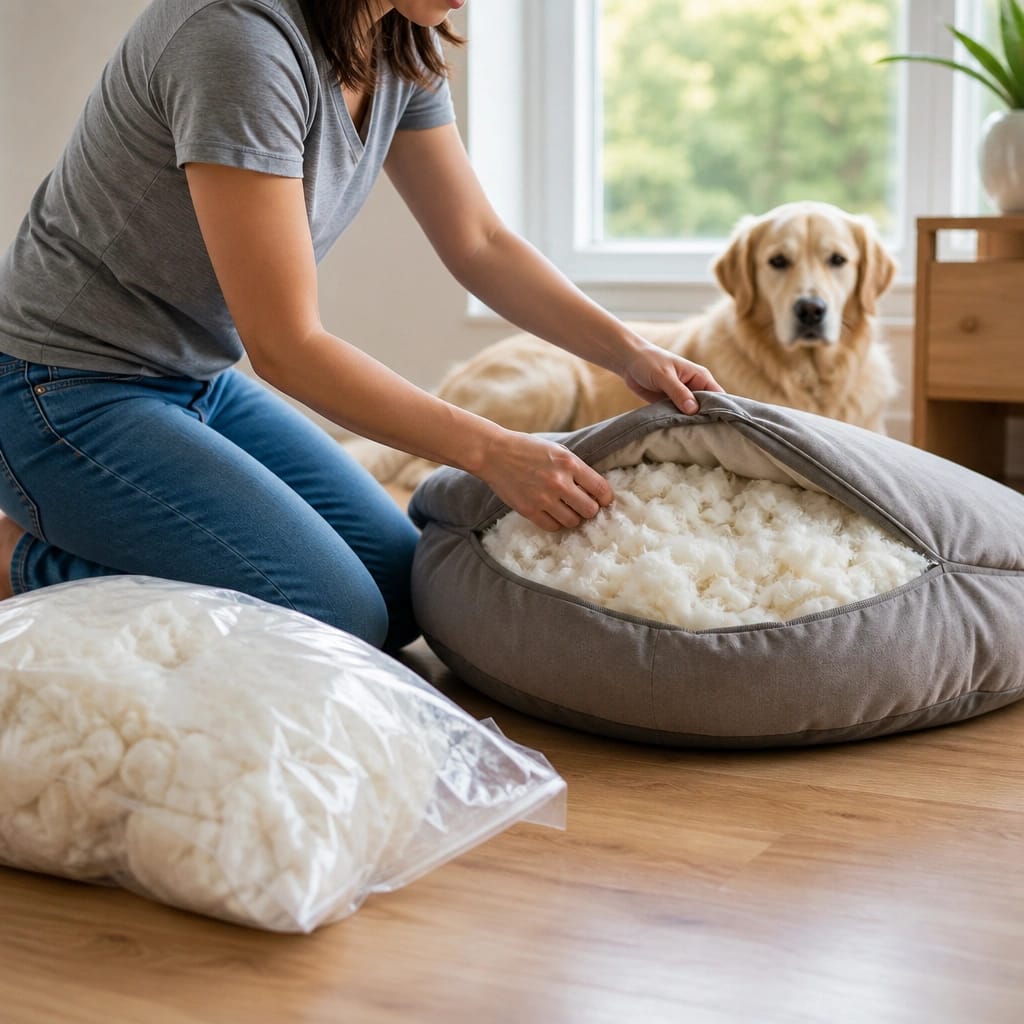
Is It Time to Replace Your Dog Bed Filling
Not every flat bed needs a full refill. Some just need a good fluff and a day in the sun. But if you’re seeing any of these signs, it’s time to replace the filling.
Signs your bed needs new filling:
- The bed is visibly flat with no loft
- You can feel the floor through the cushion
- The filling has shifted into clumps or thin spots
- There’s a permanent dip where your dog sleeps
- The bed smells musty or moldy
If your dog has started sleeping on the floor instead of their bed, that’s a strong signal. A flat, unsupportive bed is uncomfortable. Dogs vote with their bodies.
Our research shows that heavier dogs compress standard polyester fiberfill in about 12 to 18 months. That’s the typical timeline for a refill.
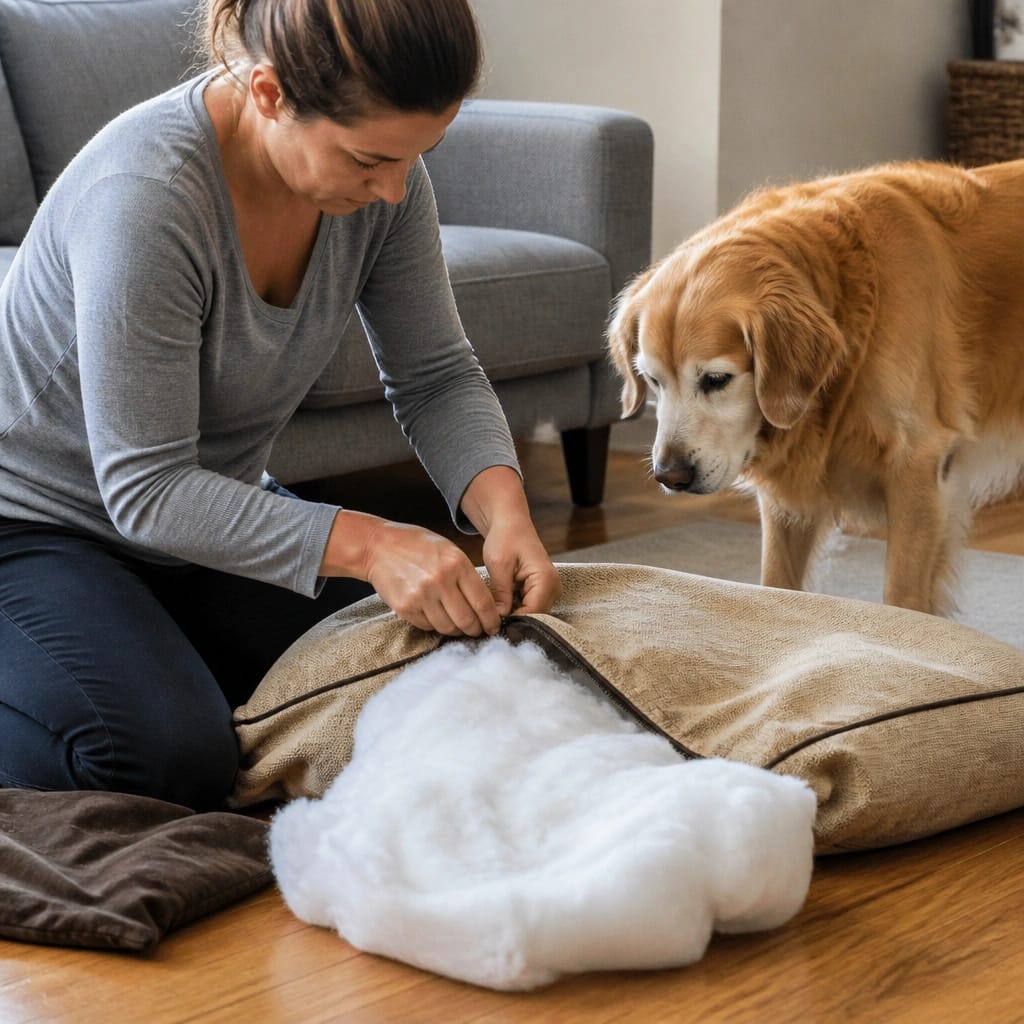
Should You Refill or Buy a New Bed
This is the real question. And the answer depends on a few things.
Refill your bed if:
- The cover is still in good shape
- The zipper or seams are intact
- Your dog likes the bed shape and size
- The bed cost more than $50 to $80 originally
- You want to keep a familiar scent for your dog
Buy a new bed if:
- The cover is torn, stained, or worn out
- The zipper is broken beyond repair
- The bed has a strange shape that’s hard to fill evenly
- Your dog has outgrown the bed entirely
- The bed is very cheap (under $30) to begin with
The math is simple. A bag of premium polyester fiberfill costs about $10 to $15 for a small bed and $25 to $40 for a large one. Shredded memory foam runs a bit more.
Compare that to $60 to $150 for a new bed of similar quality. For most dog owners, refilling makes sense at least once.
Choosing the Right Fill: Fiberfill, Shredded Foam, or Solid Foam

You have three main options. Each works best for a different type of bed and dog.
Polyester Fiberfill
This is the standard fluffy stuffing you find in most plush dog beds. It’s soft, lightweight, and easy to work with. Good for dogs who like to nest and dig.
The downside is compression. It flattens faster than foam, especially under heavy dogs. Best for small to medium dogs or beds used as occasional napping spots.
Shredded Memory Foam
This is our top recommendation for most beds. It offers better support than fiberfill and lasts longer. Shredded foam conforms to your dog’s body and bounces back better after compression.
It’s heavier and more expensive, but it holds up well under dogs over 40 pounds. Works great in bolsters and donut beds too.
Solid Foam Block
This is for beds with a single foam core. You’ll need to cut the foam to size with an electric knife or serrated blade. It’s the most supportive option for senior dogs or dogs with joint issues.
But it’s the least forgiving. If you cut wrong, you’re stuck. Good for rectangular beds with a flat foam compartment.
Quick comparison table:
| Fill Type | Best For | Support Level | Cost per Bed | Lifespan |
|---|---|---|---|---|
| Polyester fiberfill | Small dogs, plush beds | Low to medium | $10-$25 | 12-18 months |
| Shredded memory foam | Medium to large dogs | Medium to high | $20-$50 | 24-36 months |
| Solid foam block | Senior dogs, orthopedic needs | High | $30-$60 | 36-48 months |
Measuring the Bed and Calculating Fill Amount
You need to know how much fill to buy. Getting this wrong means either a lumpy overstuffed bed or a flat pointless one.
For fiberfill: Measure the bed’s length, width, and height in inches. Multiply them together (L x W x H) to get the volume in cubic inches. Divide by 28 to get the approximate cubic feet you need.
A 30 x 20 x 4 inch bed is 2400 cubic inches, which is about 86 cubic feet. You’ll need roughly 2 to 3 pounds of fiberfill for that size.
For shredded foam: Use the same volume calculation. But plan to buy about 10 to 20 percent more than the math suggests. Shredded foam settles and compresses more than fiberfill during stuffing.
You can always remove excess, but you can’t add more later if you run short.
For solid foam: Measure the exact inside dimensions of the foam compartment. Order a precut block or buy a sheet and cut it yourself. Add an inch in each direction if you want a snug fit.
Foam cutters at most craft stores can trim it for you.
Pro tip: If you’re refilling a familiar bed, weigh the old fill on a kitchen scale before you toss it. That gives you a direct target for the new material. Most small beds use 1 to 2 pounds.
Medium beds use 3 to 5 pounds. Large beds use 5 to 8 pounds.
Step-by-Step Guide to Replacing Dog Bed Filling

Now the actual work. Here’s the process.
Step 1: Open the bed
Most beds have a zipper. Find it. It’s often hidden under a flap or along the back seam.
If there’s no zipper, you’ll need to open a seam. Use a seam ripper (shown above) to carefully cut the stitching. Go slow.
You’ll need to sew it back up later.
Step 2: Remove the old fill
Pull out the old stuffing. Wear a dust mask if the fill is old or dusty. Discard the old material.
If the filling is moldy or smelly, bag it immediately and seal it. You don’t want those spores in your house.
Step 3: Clean the cover
Wash the empty cover. Check the care label first. Most are machine washable on cold.
Let it air dry completely. Even a slightly damp cover can trap moisture and cause mold in the new fill.
Step 4: Insert the new fill
This is the slow part. For fiberfill, pull the material apart into loose handfuls. Stuff it into the corners first.
Use a chopstick or ruler to push fill into tight spots. For shredded foam, pour it in slowly and shake the bed to distribute it. For solid foam, slide the block into the compartment.
Step 5: Check the loft
Zip the bed partially closed. Feel the surface. Add more fill to thin spots.
Remove fill from bulging areas. The goal is even thickness across the whole bed. Close the zipper fully once you’re happy.
Step 6: Close the bed
Zip it shut. If you opened a seam, sew it closed with a strong needle and thread. A ladder stitch works well.
It’s invisible from the outside and holds up to digging.
Step 7: Fluff and shape
Shake the bed. Pat it down. Fluff the bolsters if your bed has them.
Let it sit for a few hours so the fill settles. Then let your dog test it.
How to Handle Bolsters, Donut Beds, and Sofa-Style Beds
These shaped beds are trickier. Bolsters need separate filling. Donut beds need even distribution around the whole ring.
For bolsters, remove the old fill from the raised edge channel. Stuff new fill in firmly. Use a ruler to push it to the far end.
Donut beds work best with shredded foam. It fills the curved shape evenly without lumping.
Common Mistakes That Ruin a Refill Job

The biggest mistake is overstuffing. Too much fill makes the bed lumpy and uncomfortable. Your dog will avoid it.
Another mistake is using the wrong fill type. Fiberfill in a heavy dog’s bed flattens in weeks. Shredded foam in a lightweight bed feels too firm.
Match the fill to your dog’s weight and sleeping style. Skip the cheap fill. It compresses faster and costs you more in the long run.
When It’s Not Worth Replacing the Filling
Sometimes a refill doesn’t make sense. If the cover has holes, tears, or broken zippers, you’re better off starting fresh. The same goes for beds with deep stains or odors that won’t wash out.
If the bed originally cost under $30, a refill probably isn’t worth your time. The cover won’t last long enough to justify the effort. And if your dog has outgrown the bed entirely, just buy a bigger one.
Cost Comparison: Refill vs. New Bed
Here’s the real math. A refill costs $15 to $50 depending on size and material. A new bed of similar quality costs $60 to $150.
That means refilling saves you about 60 to 70 percent. The only catch is your time. You’ll spend 30 to 60 minutes on the job.
For most people, that’s well worth the savings.
How to Make Your Refilled Bed Last Longer
Rotate the bed every few weeks. Fluff it by hand or give it a good shake. Keep it out of direct sunlight.
UV rays break down foam and fiberfill over time.
Wash the cover regularly. Dirt and oils from your dog’s coat accelerate fill compression. A clean bed lasts longer.
If your dog digs or scratches before lying down, that behavior can wear out fill faster. A durable cover helps slow the damage.
Quick Decision Guide: What to Do Based on Your Bed Type
Flat rectangular bed with zipper: Refill with shredded memory foam. Easy to open, easy to close. Best candidate for a refill.
Bolster or sofa-style bed: Refill the base with shredded foam. Refill the bolsters separately with fiberfill for a softer feel. Keep them distinct.
Donut or round bed: Use shredded foam. It fills curved shapes evenly. Fiberfill clumps in donut beds.
Solid foam core bed: Replace the foam block. Measure the compartment first. Order a precut block or cut your own.
Sewn-shut bed with no zipper: Open a seam with a seam ripper. Refill. Sew it closed with a ladder stitch.
Only do this if the cover is in great shape.
Cheap bed under $30: Buy a new bed. The cover won’t survive long enough to justify the refill.
Frequently Asked Questions
How often should I replace dog bed filling?
Every 12 to 18 months for fiberfill. Every 24 to 36 months for shredded foam. Solid foam blocks last 3 to 4 years.
Can I wash the old filling?
No. Washing destroys the structure of fiberfill and foam. Replace it instead.
Only wash the cover.
What’s the best fill for a heavy dog?
Shredded memory foam. It holds up better under weight. Fiberfill flattens too quickly for dogs over 40 pounds.
How do I know how much fill to buy?
Measure the bed’s volume in cubic inches. Divide by 28 for cubic feet. Or weigh the old fill and match that amount.
Can I mix different fill types?
Yes. Many owners use shredded foam for the base and fiberfill for bolsters. Just keep them in separate compartments.
Is it cheaper to refill or buy a new bed?
Refilling saves 60 to 70 percent. A refill costs $15 to $50. A new bed costs $60 to $150.
The tradeoff is 30 to 60 minutes of your time.


