

How to Make a No-Sew Dog Bed
Fleece throws and a bag of polyester stuffing are all you need to build a comfortable dog bed in about an hour. No sewing machine, no needle and thread, just a pair of sharp scissors and a double-knot technique that holds up to daily use. This guide walks you through measuring, cutting, and tying a no-sew bed that fits your dog’s sleeping style, and it’s fully washable when you’re done.
Image source: Wikimedia Commons / David J. Fred (CC BY-SA)
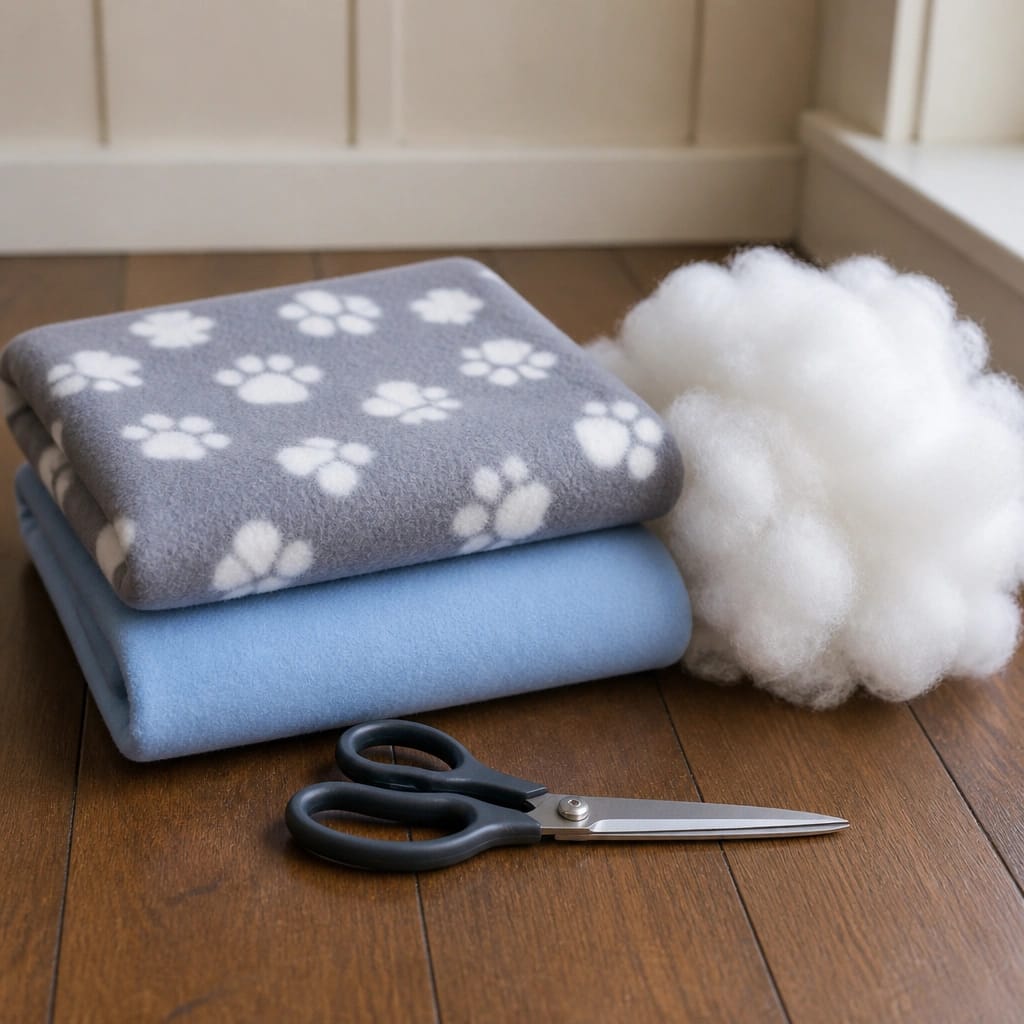
What You’ll Need Before You Start
Gather these supplies before you begin. The list is short, and everything is available at craft stores or online.
- 2 pieces of fleece fabric, one for the top, one for the bottom. Anti-pill fleece is the best choice because it doesn’t fuzz up after washing.
- Polyester fiberfill, about 2 to 4 pounds depending on how thick you want the bed. This gives the cushion its loft and softness.
- Sharp fabric scissors, regular scissors will fight the fleece and wear out quickly.
- A ruler or measuring tape, for cutting consistent fringe strips.
- Chalk or a washable fabric marker, for marking the cutting line.
- Cardboard or newspaper for a reusable template if you’re making more than one bed.
The fleece yardage depends on the final bed size:
| Bed dimensions | Fleece per side | Fill needed |
|---|---|---|
| Small (18″ x 18″) | 22″ x 22″ square | 1 to 1.5 lbs |
| Medium (24″ x 24″) | 28″ x 28″ square | 2 to 3 lbs |
| Large (30″ x 30″) | 36″ x 36″ square | 4 to 5 lbs |
You’ll assemble the fabric fringe-down, knot the two pieces together around the edge, and use a center slit to stuff the cushion. That’s the whole technique right there. If you can tie a shoelace, you can build this bed in about an hour.
Midway through tying, when the shell is about two-thirds closed, you insert the filling and then close the opening. The result is a washable, customizable bed your dog can actually use. No sewing machine, no glue, no special tools.
Fleece Requirements: Don’t Skimp Here
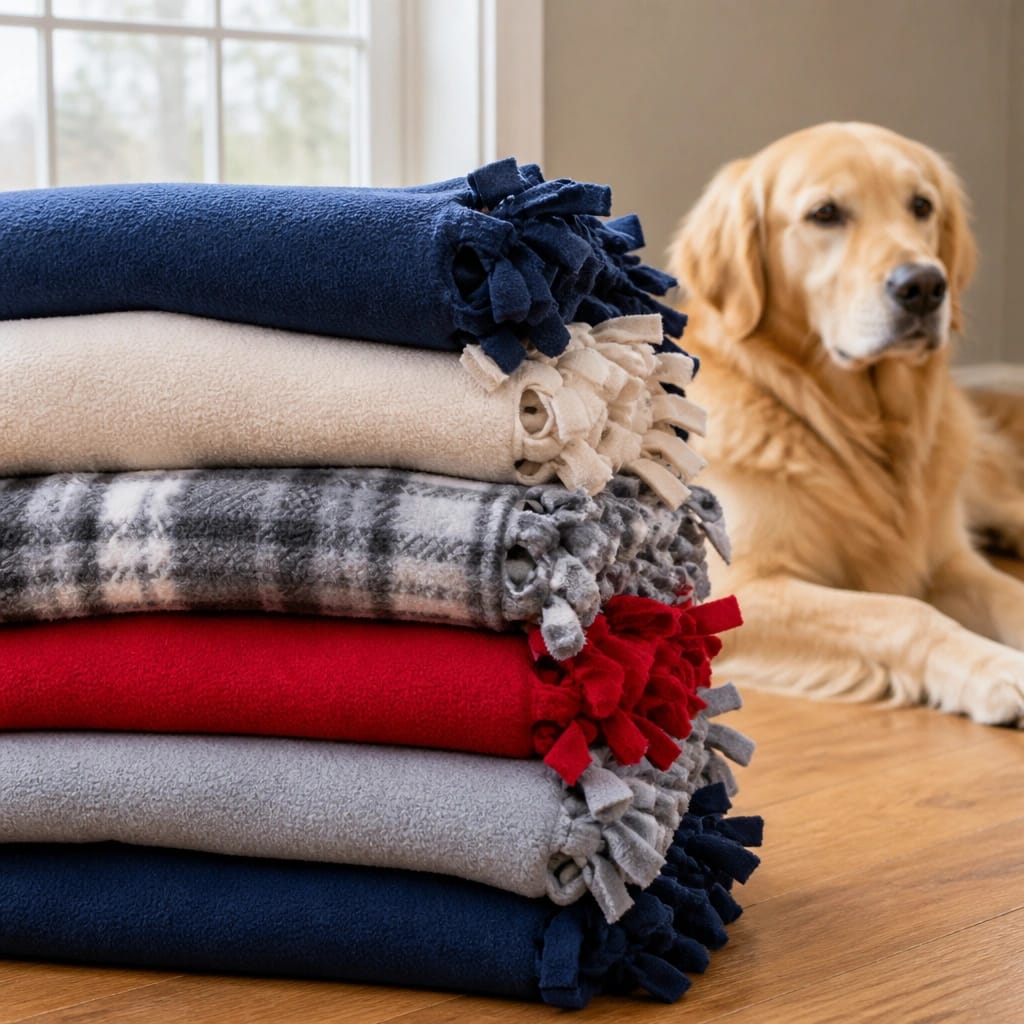
The biggest mistake beginners make is buying the wrong fabric. You need anti-pill solid fleece or blizzard fleece, not acrylic craft felt and not polar fleece with a thick nap.
- Anti-pill fleece: best all-around choice, holds knots well, doesn’t fuzz.
- Blizzard fleece: softer, slightly stretchier, fights knots loosening less than anti-pill (it’s still fine with knots tied snugly).
- Avoid polar fleece selvage edges that are too thick, double knots become difficult.
For a medium-sized dog (20, 30 lb), you’ll need 1.5, 2 yards of fleece (two pieces) and a 20-inch square pillow / loose fill. For large breeds, go 2.5+ yards per panel.
sectionIntent: side-by-side comparison of fleece panel sizes
sectionQuery: “stacked fleece fabric panels on table craft project” (photo)
Hero Image: The Finished No-Sew Dog Bed
alt: “dog sleeping on no-sew tie fleece bed” | photo credit: Unsplash
How Big Should Your No-Sew Bed Be?
The bed size needs to match your dog’s body, not your living room. A bed that’s too small means your dog hangs off the edge. Too large wastes fill and creates soft, unsupported spots.
| Dog Weight | Finished Bed Size | Fleece Panel Size (each piece) |
|---|---|---|
| 5–15 lb (toy breeds) | 18″ × 18″ | 24″ × 24″ |
| 15–30 lb (small/medium) | 24″ × 24″ | 32″ × 32″ |
| 30–60 lb (medium/large) | 30″ × 36″ | 38″ × 44″ |
| 60+ lb (large/giant) | 36″ × 48″ | 44″ × 56″ |
Measure your dog from nose to tail base while they sleep curled up. That measurement plus 6, 8 inches equals your finished bed width. The panels need 2× that width in total fleece.
Step 1: Measure and Cut the Fleece
What you’ll see: A top panel and bottom panel of identical size, stacked.
Use a rotary cutter and self-healing mat for straight edges, or sharp scissors. Cut two rectangles of equal dimensions (see table above). Then:
- Cut off the finished selvage edges so the fabric is uniform.
- Stack both pieces perfectly aligned. Smooth out wrinkles.
- Mark a 4″ perimeter border on the top fabric with chalk.
- Cut 4-inch squares out of each corner, removing all layers.
For the visual: search “stacked fleece fabric panels on table craft project”, the photo should show both panels stacked with edges aligned.
sectionIntent: demonstrates the fringe-cutting step that makes the no-sew method possible; shows hands cutting straight strips into the fleece edges.
The Fringe Cut That Makes It Work
The classic no-sew bed is simply two layers of fleece tied together at the edges. But the four-corner tie version (which makes a real pillow-like bed, not just a flat blanket) starts with the fringes.
Lay both fleece rectangles on top of each other, right sides facing out, edges perfectly aligned. From one edge, cut strips 1 inch wide and 6 inches deep, every 1-inch apart. Cut strips on ALL FOUR sides.
Each cut creates a pair of matching strips (front layer + back layer). That’s your “fringe”.
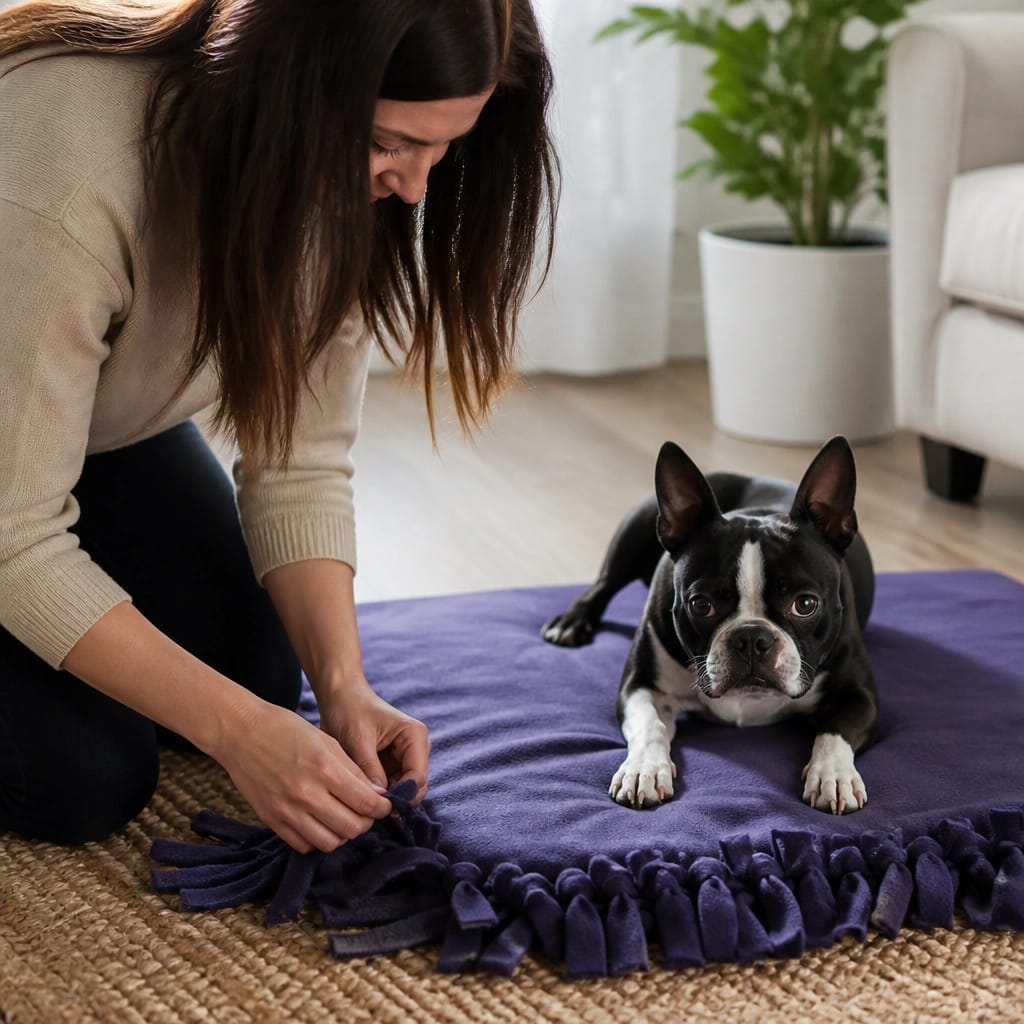
Then tie every pair together in a double knot. That’s it. The knot pulls the two layers together edge-to-edge, forming a removable pouch.
Pro tip: Do not cut the fringe too deep, keep it to 4, 6 inches on smaller beds or the seam line puckers in weird ways when the stuffing goes in.
Fill It the Smart Way
Open the pouch (leave the last side untied for now), then add polyester fiberfill in portions rather than one giant lump. Break it up by hand, fluffed fill is what gives the bed that cloud-like loft. A 10- to 12-inch-thick layer works for most dogs.
If you’re using an old pillow or duvet insert, redistribute the insulation evenly to avoid clumping.
After filling, shake the bed gently by the corners so the stuffing settles evenly, then tie the remaining fringe closed mkdir kgleather weed barrier landscape fabric alternativesand you’re done.
Do not overstuff the corners, they become lumpy and hard for the dog to curl into, and they make the knots pull tight unevenly.
Prepping the Fabric
- Wash and dry both fleece panels first. Fleece shrinks slightly; wash before cutting so measurements stay true.
- Lay one panel flat on a large table or clean floor.
- Place the second panel directly on top, aligning the edges perfectly.
- Trim away any selvage edge that isn’t even.
This matters. If your two rectangles don’t match, the knots will pucker and the bed looks sloppy.
Cutting the Fringe
Every side of the folded fleece gets a fringe that becomes your knots. Use a rotary cutter for straight lines, or fabric scissors if you prefer.
- Cut a 4×4 inch square from each corner (removes the bulk).
- Cut 4, 5 inch deep notches every 1 inch along all four edges.
- Keep the cuts even, closer spacing = firmer seal; wider spacing = roomier ties.
For a visual, imagine cutting fringe on both layers at once. Don’t overthink it, 1-inch strips spaced roughly 1 inch apart work fine.
Fill the Inside and Tie It Shut
Place the filling: put the two fleece rectangles wrong sides together (the soft outer sides facing out). Spread your pillow / poly-fill evenly between them)Skip the fill into the middle so the sides stay flat for tying.
Work your way around all four sides:
- Grab the top and bottom fleece strip together (one pair of fringe).
- Tie a double knot close to the edge.
- Move to the next strip, don’t skip.
- Keep a consistent knot tension (not too loose, not cinched too tight).
As you finish each side, check that the filling stays spread. When all ties are knotted, fluff the bed and run your hand along the edges to confirm every strip is sealed.
Mistakes to Avoid with a No-Sew Bed
- Not accounting for seam allowance: strips need to be longer than you think, leave at least 拉拉3, 4 inches per knot per side.
- Corners that are too narrow: cut the corner strips adjacent but never at the actual corner (that’s a hole sacrifice). Tie them slightly diagonal instead.
- Overstuffing, the bed will puff up unevenly and it’s harder to tie the final edge.
- Skipping the pre-wash: fleece shrinks up to 5% on the first wash. Pre-wash and dry before you cut, not after you tie.
Knot types: single vs. double
For a dog bed, double-knot the fringe, the first knot is the one that holds; the second knot locks it and prevents slipping through. You can also try a slip-knot if you plan to pull the whole cover off regularly for washing.
Step 1 – Cut Your Fleece Panels
Place both pieces of fleece wrong sides together (the soft side facing in). For a small-medium dog, you’ll want 2 panels about 24″ x 30″ each. Comfortable bed height for a 30 lb dog is around 4 inches of fill.
Cut completely through both layers at once:
- Trim edges so both rectangles are perfectly aligned.
- Cut out a 4×4-inch square from every corner (through both layers).
- Cut 1-inch wide × 4-inch deep fringe strips along all four sides.
Don’t stress if strips aren’t identical. 1″ spacing is forgiving enough. Just aim for even depth.
Choosing the Right Fill
The fill determines how comfortable and how washable the bed stays. Three options are common for a no-sew construction:
- Polyester fiberfill: soft, lightweight, cheapest. Flattens after a few months but works fine.
- Shredded memory foam: heavier, better support for older dogs, but harder to remove for washing.
- Recycled pillow fill: if you have old pillows, batch the fill from them, it clumps, so stash it in a removable inner pillowcase.
Whether you choose loose fill or a pre-made pillow insert, use a removable cover. That way, the washable shell pulls off while the inner stays intact, and your D.I.Y. bed actually survives the washing machine.
Marking and Cutting the Fleece Panels
For a 30-inch square finished bed:
- Lay both rectangles flat on a protective mat or table.
- Trim heavy selvedge edges if the fleece has them.
- Stack the two pieces with all edges perfectly aligned. Smooth out wrinkles. Pin or clip every 10″ around the perimeter.
- Mark the fringe line: measure 1.5, 2 inches from each edge. Draw a square outline using tailor’s chalk or a washable fabric marker.
- Mark tie notches: every 1.5, 2 inches around the outline, make small tick marks.
For a legitimate bed structure, you don’t cut fringe all the way to the edge, you cut a border fringe band (quilting-safe). Tie each upper and lower strip into a square knot.
H2: Choosing the Right Fleece for Pets
Use anti-pill fleece, it doesn’t fuzz after 10 washes. Polar fleece works too. Avoid minky or velvet unless you want to buy two separate panels and don’t mind more lint transfer.
Fleece selection notes:
| Property | Good choice | Avoid |
|---|---|---|
| Fiber | 100% polyester fleece | Acrylic wools (itchy, static) |
| Weight | Medium/medium-heavy (275–350 gsm) | Ultra-light thin fleece (tears easily) |
| Stretch | Minimal 2-way stretch only | 4-way stretch that warps ties |
| Pattern | Solid or small print | Large prints distort when cut |
Wash both panels before cutting. Fleece shrinks slightly (1, 3%) on the first wash, and the finished bed will pucker if you skip this step. Pre-shrink, then measure.
Cutting the Panels: Measurements That Matter
Lay both fleece panels on top of each other. Trim so they are identical rectangles. The fleece should be larger than your final pillow, because the knot fringe takes away 2, 3 inches per side.
| Dog Weight | Fleece Rectangle (each panel) | Final Bed Size |
|---|---|---|
| under 10 lb | 24 × 24 in | ~18 × 18 in |
| 10–25 lb | 30 × 30 in | ~24 × 24 in |
| 25–50 lb | 36 × 36 in | ~30 × 30 in |
| 50–75 lb | 40 × 48 in | ~34 × 42 in |
| 75+ lb | 44 × 52 in | ~38 × 46 in |
Step 1: Cut the Fringe
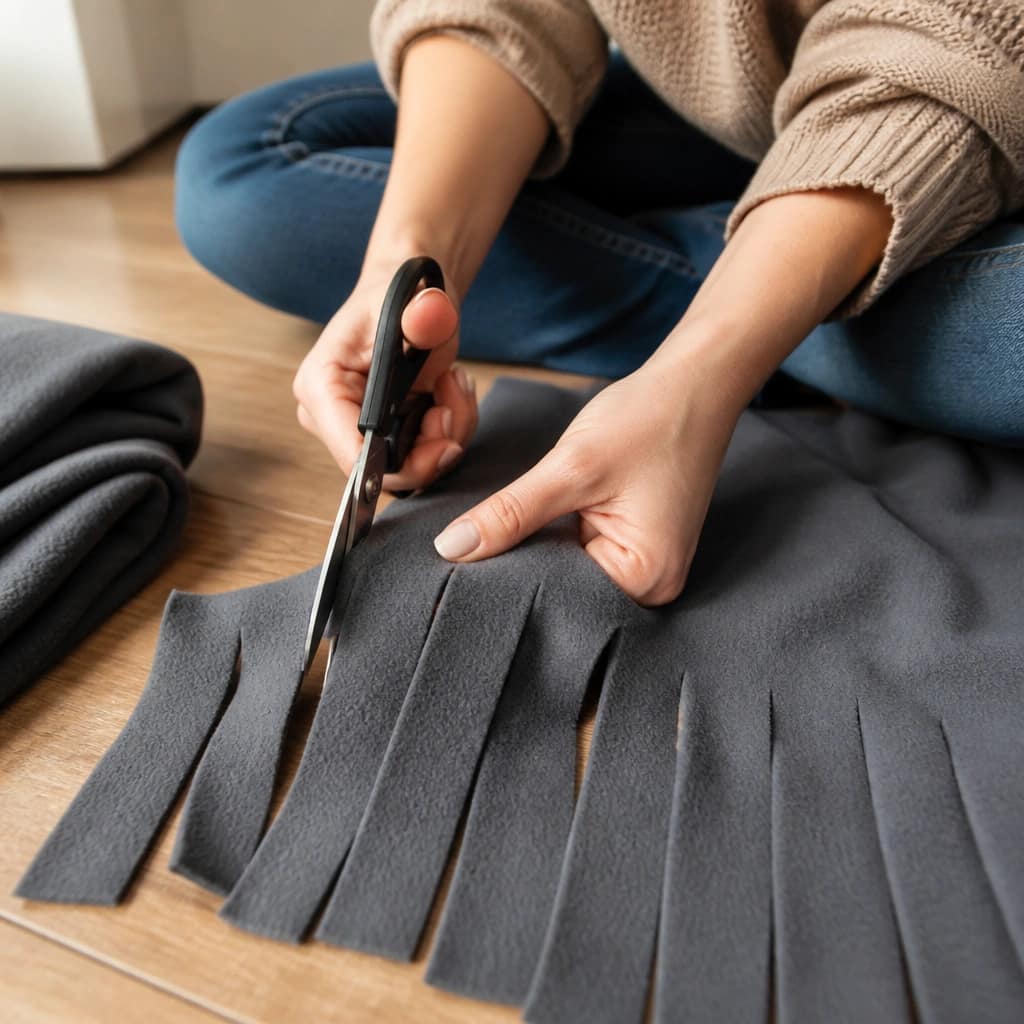
Lay the two fleece panels perfectly aligned, wrong sides together. Cut a 2-inch fringe strip along all four sides, through both layers. Each fringed strip is about 1 inch wide.
Don’t cut past the fringe line. If you need accuracy, mark a 2-inch border with tailor’s chalk before cutting.
Step 2: Tie the Knots
Working along all four sides, tie each paired fringe strip together. Use a double knot, first a standard knot, then a second knot on top. A double overhand knot holds even with heavy movement.
Work systematically: one corner to the next, keeping tension consistent. Leave a gap of about 8-10 inches on one side for the filling opening.
Step 3: Stuff the Cushion
Open the gap you left. Choose your fill:
- Polyester fiberfill, softest, washes poorly (often clumps).
- Shredded foam, holds shape, heavier.
- Old pillow inserts, cheapest and a great recycling hack.
- Memory foam chunks, firm but require a removable cover for washing.
Fill until it’s about 80% puffed, not bursting. Too tight keeps the knots from lying flat; too loose makes a sad-looking pancake bed.
Step 4: Tie the Opening Shut
Finish the gap with the same fringe-and-knot technique used on all four sides. Run your fingers along each knot and pull tight. Flip the bed over and check all corners, the fill settles.
Should You Use a Pillow Insert Instead?
Yes, if you want a removable cover. Make the same fleece sandwich, but before tying it shut, slide a quilted square or a washable dog bed insert inside. Sew or knot the final edge after inserting.
Using an insert changes the care routine: you remove the insert, then machine-wash the fleece cover on cold and air-dry it. Loose fill (polyester stuffing) cannot be removed, you will have to remove the stuffing before washing the cover.
How to Wash a No-Sew Dog Bed
Flea species and bedding hygiene are a real issue in many regions, washing matters. For a no-sew dog bed made from fleece:
- Shake out loose fur outside.
- Machine wash on cold, gentle cycle.
- Tumble dry on low heat.
- Spot clean stains immediately to avoid setting them.
Fleece is synthetic and dries quickly, which helps when your dog has accidents or rolls in mud. Avoid fabric softeners, they coat the fibers and reduce softness.
Why This Works for Your Dog
Dogs like beds that smell like them. A fleece no-sew bed is soft enough for older dogs with joint pressure but thick enough to insulate from a cold floor. The knot method makes it durable, those doubled ties hold up well to scratching and nesting.
If you’re expecting a puppy, keep this design in mind, you can make the outer shell and fill it with a removable pillow insert, making washing much easier. Puppy accidents happen.
Frequently Asked Questions
How long does a no-sew fleece dog bed last?
With average indoor useaine, meaning daily napping, minimal scratching, a fleece no-sew bed lasts 1, 2 seasons. Look for frayed or loosening knots that could become chew hazards)Skip.
Is a no-sew fleece bed safe for a chewer?
Not if your dog actively chews fabric. The knots and fringe are tempting. If your dog is an aggressive chewer, skip this bed entirely and use a tightly woven cover instead.
For normal chewers, supervise the first few uses.
How do I wash a no-sew dog bed?
If you tied the fleece around a pillow form, untie one side and pull the pillow out. Wash the fleece case in cold water on a gentle cycle. Tumble dry on low.
The fleece won’t shrink if you keep it on the coolest dryer setting.
What to Put Inside
Standard couch pillow (good), a bulk bag of polyester filling (better), or a structured pet bed foam insert (best).
For a softer bed, use 1, 2 pounds of loose poly-fil. For orthopedic support, use a flat foam slab cut to size and remove the core ball before washing.
This YouTube tutorial shows the full tie process in under three minutes.
Caring for Your No-Sew Dog Bed
Most fleece stands up to a machine wash on gentle/delicate. Remove the filling first if you’ve used loose fiber. If you’ve got orthopedic foam inside, wipe down the cover instead.
Tumble dry low or air dry flat. Fleece resists wrinkles and dries fast. If you tied your knots tight and left at least 1 inch of fringe, the knots won’t pull through in the wash.
When to Replace the Fill
Fleece holds up for years trim-wise, but the filling flattens. Replace loose polyester fiberfill when the bed loses its loft. If your dog sleeps on it daily, re-loft automatically every few weeks by kneading and fluffing by hand.
When a store-bought bed would cost $30, $50 for the same size, rebuilding the inner fill for $10 lets you keep the same cover for another round. That’s where the no-sew version really pays off.
Final Word on Edge Cases, If your dog is a digger/chewer, skip the no-sew bed. Woven edges hold up better to paws and teeth. But for the average family dog, this is a two-hour weekend project that produces a better bed than many $40 store-bought ones.
Product Recommendations & Manufacturer Quality
If you’d rather buy than DIY, look for these features:
- Machine-washable cover with a zipper you can actually open
- Anti-slip bottom (useful for older dogs climbing in)
- Removable inner cushion insert, not just loose fill
- Chew-resistant fabric (Cordura or heavy canvas) for puppies
For a DIY version, you only need fleece and stuffing, so skip the clever fasteners and branding.
When Is a No-Sew Bed Not Enough?
A tie-fleece bed works best as a comfy spot inside. It won’t handle chewing, isn’t waterproof, and needs regular washing. You should choose a different bed if your dog:
- Chews fabric (risk of eating fleece fringe)
- Is incontinent or recovering from surgery
- Needs orthopedic support for arthritis or hip issues
- Sleeps in a crate where fit precision matters
For senior dogs or dogs with joint pain, a flat fleece pad won’t provide enough support. Look into an orthopedic or memory foam bed instead. This DIY project is for a comfy nap bed, not a joint-support solution.
Also, if your dog is a fabric destructor, avoid this project entirely. Ingested fleece can cause dangerous intestinal blockages.
How to Wash Your No-Sew Bed
If you used a solid pillow insert, unzip it and remove it before washing the fleece cover. If you used loose fill, the bed itself is not machine washable, spot-clean it instead.
Wash the fleece cover in cold water on a gentle cycle. Tumble dry on low heat. Avoid fabric softeners, they break down fleece fibers quickly)Skip heat drying; fleece can melt or warp.
If your dog sleeps outdoors occasionally, choose blaze orange fleece for visibility (hunting season in wooded areas) and double up the base layers for extra insulation.
For heavier chewers, reinforce the seams with an extra row of knots, it’s worth the extra 10 minutes.
Maintenance Tips to Extend the Life of Your Bed
- Machine wash on cold, gentle cycle. Fleece resists shrinking but not high heat.
- Air dry flat or tumble dry on no heat. High heat melts polyester fleece over time.
- Fluff the fill weekly to keep the bed from becoming flat and lumpy.
- If using pillow filling, place it in a cotton pillowcase before inserting into the fleece, easier to remove for washing and easier to replace.
Final Thoughts: When to Make a No-Sew Bed vs. Buy One
A no-sew fleece bed is the right call when you want a custom-sized, low-cost bed in under an hourб However if your dog is a heavy chewer, choose a durable chew-proof dog bed, fleece ties can be destroyed quickly by determined pups. Also, for senior dogs with joint pain, an orthopedic foam bed is better, fleece doesn’t provide enough support for arthritis. Make the no-sew bed for a healthy younger dog and buy a joint-support bed for a senior.


